Paying for a hotel

For US travelers

How to pay less on hotels.

Checked Sep 2026

The price you compare is almost never the price you pay. A government adds a tax you did not see, the property adds a charge it set itself, and somewhere inside the number you were quoted sits a commission that has nothing to do with your room. This page is about seeing through all of that and paying less, wherever you book.

The 30-second version

  1. Compare the final total for the same room, matching cancellation terms, meals, taxes and mandatory fees before you compare two numbers.
  2. Check the hotel's own site once. It takes a minute and it is the only way to see whether the total you were shown is the total.
  3. If it is an independent property, ask for a better direct rate or a useful inclusion. The ask is free and the answer is often no.
  4. Get the total, the inclusions, the payment currency and the cancellation deadline in writing. This is worth more than any rate you negotiate.

Every one of those is bounded below by where it stops working. If you are booking in the US, read the rate-parity row for the United States first: it is the reason tactic one is weaker here than in Europe.

What this page is notIt is not about where to book, and it never will be.

We do not compare rates, we do not surface live prices, and we will never tell you a booking site is a good or a bad place to buy a room. Every tactic below works the same whichever site you end up on. Where we explain how an intermediary makes its money, that is mechanism, not a verdict.

Where booking direct can legally be cheaper

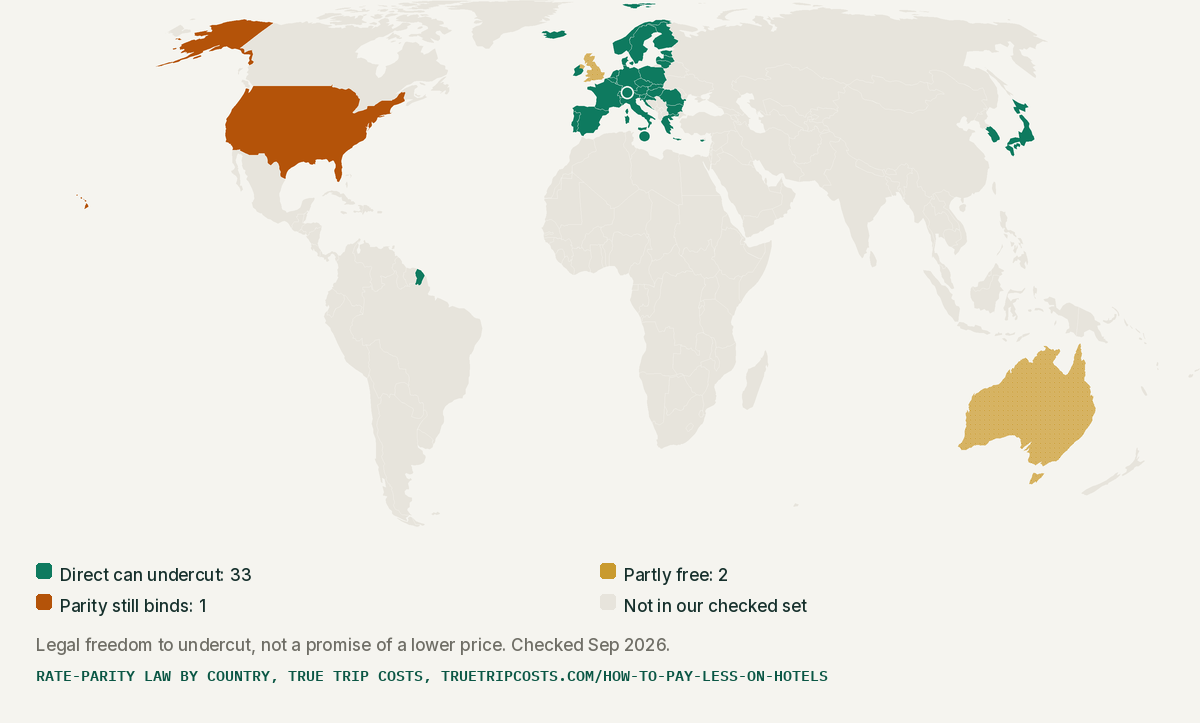
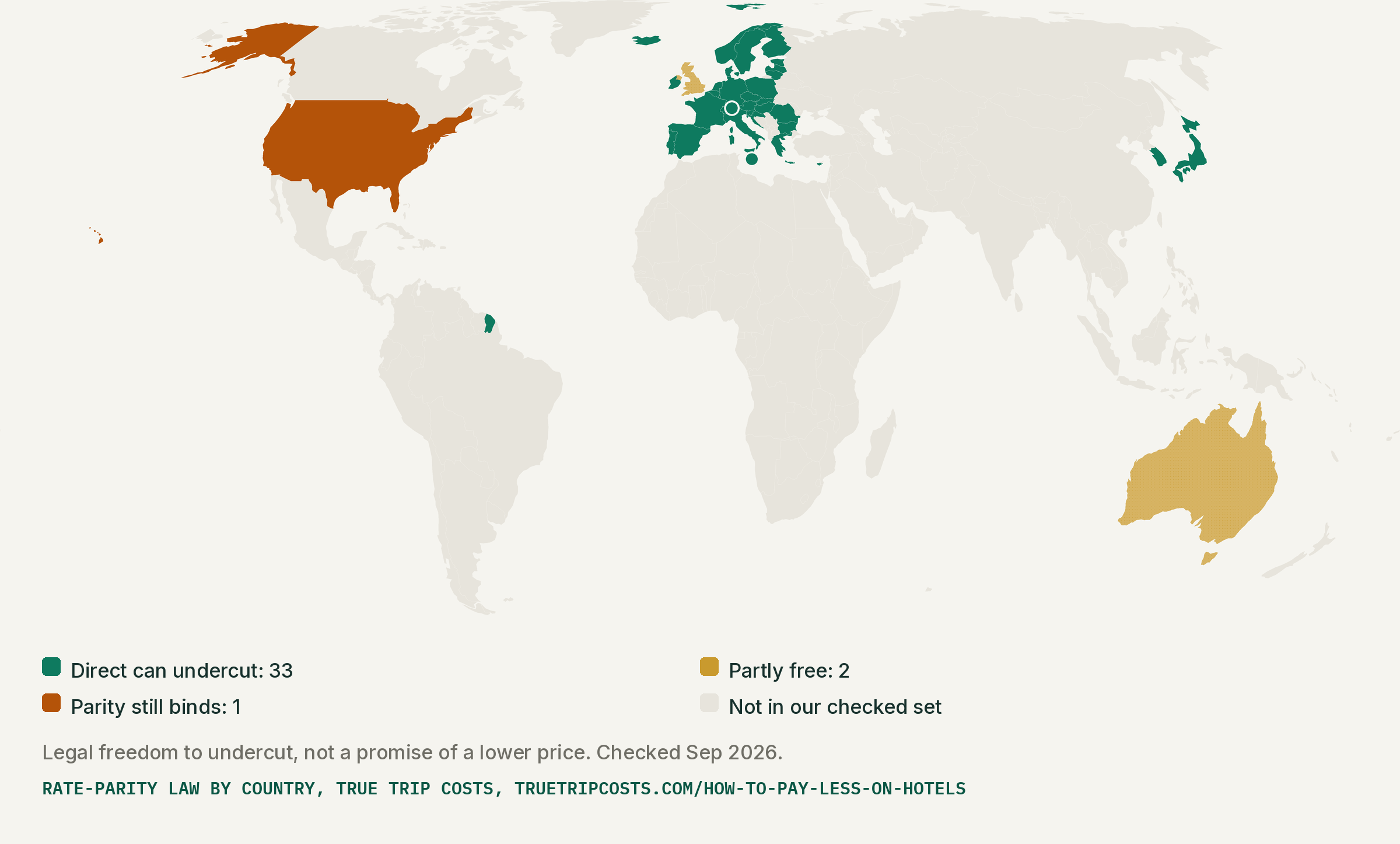
Rate parity is the contractual term that stopped a hotel offering a better price on its own site than on a platform. Across most of Europe it is now void or prohibited, which is what makes tactic five worth the thirty seconds. In the US there is no parity ban at all, which is the single most important row in this table for anyone reading this from home.

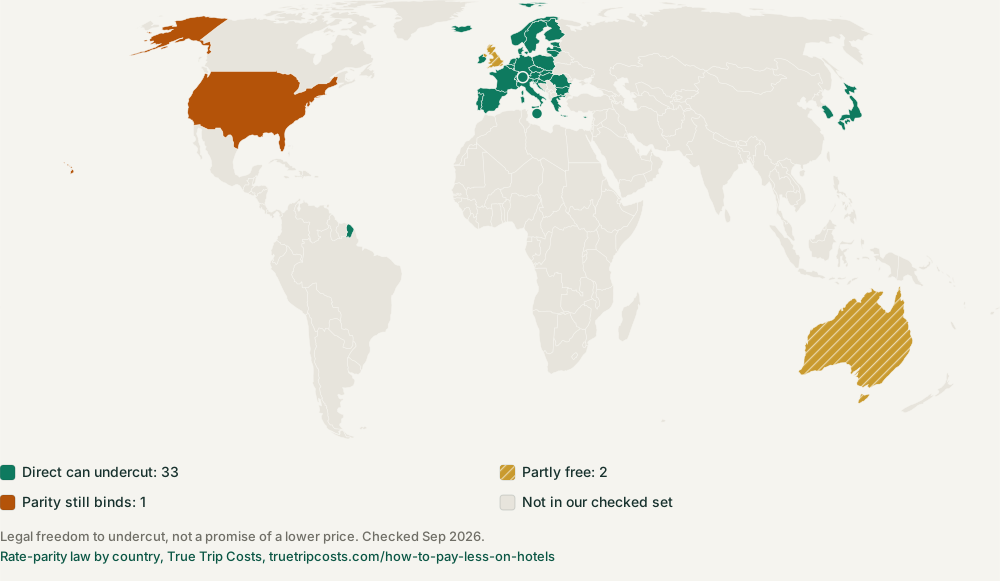
Among the 36 countries in our checked set, hotels are legally free to undercut booking sites in 33; 2 are only partly free, and the United States is the only checked country where parity can still bind.

The map shows where a hotel is legally free to offer a cheaper direct rate. That is not a promise the direct rate will be cheaper. Grey means a country is not in our checked set, which is not the same as parity applying there.

Afghanistan: not in our checked setAlbania: not in our checked setAlgeria: not in our checked setAngola: not in our checked setArgentina: not in our checked setArmenia: not in our checked setAustralia: Partly freeAustria: Direct can undercutAzerbaijan: not in our checked setBahamas: not in our checked setBangladesh: not in our checked setBelarus: not in our checked setBelgium: Direct can undercutBelize: not in our checked setBenin: not in our checked setBhutan: not in our checked setBolivia: not in our checked setBosnia and Herzegovina: not in our checked setBotswana: not in our checked setBrazil: not in our checked setBrunei: not in our checked setBulgaria: Direct can undercut, via the EU and EEA rulingBurkina Faso: not in our checked setBurundi: not in our checked setCambodia: not in our checked setCameroon: not in our checked setCanada: not in our checked setCentral African Republic: not in our checked setChad: not in our checked setChile: not in our checked setChina: not in our checked setColombia: not in our checked setCongo: not in our checked setCosta Rica: not in our checked setCôte d'Ivoire: not in our checked setCroatia: Direct can undercut, via the EU and EEA rulingCuba: not in our checked setCyprus: Direct can undercut, via the EU and EEA rulingCzechia: Direct can undercut, via the EU and EEA rulingDemocratic Republic of the Congo: not in our checked setDenmark: Direct can undercut, via the EU and EEA rulingDjibouti: not in our checked setDominican Republic: not in our checked setEcuador: not in our checked setEgypt: not in our checked setEl Salvador: not in our checked setEquatorial Guinea: not in our checked setEritrea: not in our checked setEstonia: Direct can undercut, via the EU and EEA rulingeSwatini: not in our checked setEthiopia: not in our checked setFalkland Islands: not in our checked setFiji: not in our checked setFinland: Direct can undercut, via the EU and EEA rulingFrance: Direct can undercutFrench Southern and Antarctic Lands: not in our checked setGabon: not in our checked setGambia: not in our checked setGeorgia: not in our checked setGermany: Direct can undercutGhana: not in our checked setGreece: Direct can undercut, via the EU and EEA rulingGreenland: not in our checked setGuatemala: not in our checked setGuinea: not in our checked setGuinea-Bissau: not in our checked setGuyana: not in our checked setHaiti: not in our checked setHonduras: not in our checked setHungary: Direct can undercut, via the EU and EEA rulingIceland: Direct can undercut, via the EU and EEA rulingIndia: not in our checked setIndonesia: not in our checked setIran: not in our checked setIraq: not in our checked setIreland: Direct can undercut, via the EU and EEA rulingIsrael: not in our checked setItaly: Direct can undercutJamaica: not in our checked setJapan: Direct can undercutJordan: not in our checked setKazakhstan: not in our checked setKenya: not in our checked setKosovo: not in our checked setKuwait: not in our checked setKyrgyzstan: not in our checked setLaos: not in our checked setLatvia: Direct can undercut, via the EU and EEA rulingLebanon: not in our checked setLesotho: not in our checked setLiberia: not in our checked setLibya: not in our checked setLithuania: Direct can undercut, via the EU and EEA rulingLuxembourg: Direct can undercut, via the EU and EEA rulingMacedonia: not in our checked setMadagascar: not in our checked setMalawi: not in our checked setMalaysia: not in our checked setMali: not in our checked setMauritania: not in our checked setMexico: not in our checked setMoldova: not in our checked setMongolia: not in our checked setMontenegro: not in our checked setMorocco: not in our checked setMozambique: not in our checked setMyanmar: not in our checked setNamibia: not in our checked setNepal: not in our checked setNetherlands: Direct can undercut, via the EU and EEA rulingNew Caledonia: not in our checked setNew Zealand: not in our checked setNicaragua: not in our checked setNiger: not in our checked setNigeria: not in our checked setNorth Korea: not in our checked setNorthern Cyprus: not in our checked setNorway: Direct can undercut, via the EU and EEA rulingOman: not in our checked setPakistan: not in our checked setPalestine: not in our checked setPanama: not in our checked setPapua New Guinea: not in our checked setParaguay: not in our checked setPeru: not in our checked setPhilippines: not in our checked setPoland: Direct can undercut, via the EU and EEA rulingPortugal: Direct can undercut, via the EU and EEA rulingPuerto Rico: not in our checked setQatar: not in our checked setRomania: Direct can undercut, via the EU and EEA rulingRussia: not in our checked setRwanda: not in our checked setSaudi Arabia: not in our checked setSenegal: not in our checked setSerbia: not in our checked setSierra Leone: not in our checked setSlovakia: Direct can undercut, via the EU and EEA rulingSlovenia: Direct can undercut, via the EU and EEA rulingSolomon Islands: not in our checked setSomalia: not in our checked setSomaliland: not in our checked setSouth Africa: not in our checked setSouth Korea: Direct can undercutSouth Sudan: not in our checked setSpain: Direct can undercutSri Lanka: not in our checked setSudan: not in our checked setSuriname: not in our checked setSweden: Direct can undercut, via the EU and EEA rulingSwitzerland: Direct can undercutSyria: not in our checked setTaiwan: not in our checked setTajikistan: not in our checked setTanzania: not in our checked setThailand: not in our checked setTimor-Leste: not in our checked setTogo: not in our checked setTrinidad and Tobago: not in our checked setTunisia: not in our checked setTurkey: not in our checked setTurkmenistan: not in our checked setUganda: not in our checked setUkraine: not in our checked setUnited Arab Emirates: not in our checked setUnited Kingdom: Partly freeUnited States: Parity still bindsUruguay: not in our checked setUzbekistan: not in our checked setVanuatu: not in our checked setVenezuela: not in our checked setVietnam: not in our checked setWestern Sahara: not in our checked setYemen: not in our checked setZambia: not in our checked setZimbabwe: not in our checked setLiechtenstein: Direct can undercut, via the EU and EEA rulingMalta: Direct can undercut, via the EU and EEA ruling

True Trip CostsLegal freedom to undercut, not a promise of a lower price. Checked .

  • Direct can undercut33 countries
  • Partly free2 countries
  • Parity still binds1 country
  • Not in our checked setNot the same as parity applying
36 countries carry a position here, from 15 rulings and statutes. The thirty EU and EEA states take their colour from one ruling that covers all of them, so they are shaded from the bloc rather than checked one by one. Malta and Liechtenstein are drawn as dots because the world outline this map uses does not draw them at all. Every colour is explained in the table below, with the ruling and the date behind it.
Use this map on your own site

Free to embed anywhere, including commercially, and it stays current on your page: as the law moves and we recheck it, an embedded copy updates itself with no re-paste. A credit link back is appreciated and not required, because the frame carries one already.

See what it looks like

Clicking the box selects the whole snippet, so it copies with one keystroke if the button is not there.

For writers and publishers: the map and the data as files

Free to reuse, including commercially, with attribution. Take the map as a vector or a raster, or the rows as data. If you would rather it stayed current on your page by itself, use the embed above instead.

  • Map, SVGRebuilt on every deploy, so it cannot go stale. Vector, so it scales into a print layout without going soft. This is the map's native format: the choropleth is written as SVG, so this is the original rather than a conversion.
  • Rows, CSVRebuilt on every deploy. Columns: jurisdiction, status, effective date, source URL, checked date. The EU and EEA ruling ships once under its own name and once per member state, each labelled as inheriting it, so sorting by jurisdiction finds Poland without the file claiming a separate Polish ruling.
  • Map, PNG 1200pxFor a web article. Carries the legend and the checked date inside the image, because a chart screenshot travels without its caption.
  • Map, PNG 2400pxFor print or a high-density screen. The two PNGs are generated files rather than live ones, so check the date printed on the image against the checked date on this page before publishing.

The method, in one sentence. Each jurisdiction is read from the statute, judgment or competition-authority action behind it, dated to when that instrument took effect, and rechecked on the date shown. The map states where a hotel is legally FREE to offer a cheaper direct rate. It does not say a direct rate will be cheaper.

Suggested attribution. Rate-parity law by country, True Trip Costs, truetripcosts.com/how-to-pay-less-on-hotels

The rulings, one row at a time

Direct can undercutParity clauses are void or prohibited, so a hotel may legally offer a better price on its own site and on other channels.

Partly freeWide clauses are gone, so a hotel may undercut on other platforms, but a narrow clause covering its own website may still bind.

Parity still bindsNo parity ban is in force, so a hotel may be contractually held to the same price it shows on a platform.

Rate parity by jurisdiction, with the ruling or statute behind each row. Checked . 11 of the 15 rows link the primary document, and the 4 that do not are named as unlinked rather than left to look sourced. 11 rows are a single country, and the 10 of those with a guide on this site link to it.

JurisdictionStatusSinceWhat changed, and the source
EU and EEA, all 27 member statesDirect can undercut14 November 2024The largest platform group was designated a gatekeeper under the Digital Markets Act on 13 May 2024, and parity clauses became prohibited for it six months later, on 14 November 2024. Hotels, car rental firms and other providers may offer better prices and conditions on their own sites and on other channels, and the gatekeeper may not raise commission or de-list an offer in response.European Commission, Booking must comply with all relevant obligations under the Digital Markets Act
EEA inventory, in the platform’s own termsDirect can undercut2 December 2024The platform’s own compliance report records that all wide and narrow parity clauses were removed for EEA inventory, with the updated terms taking effect for existing accommodation partners on 2 December 2024. This is the contractual side of the ruling above: the clause is gone from the agreement, not merely unenforceable.Booking Holdings, Digital Markets Act compliance report, public summary
European Union, competition lawDirect can undercut19 September 2024In Case C-264/23 the Court of Justice held that price parity clauses, wide and narrow alike, cannot in principle be treated as ancillary restraints under EU competition law. Neither kind was shown to be objectively necessary to run a hotel reservation platform.Court of Justice of the European Union, press release 145/2024, Case C-264/23
GermanyDirect can undercut18 May 2021The Federal Court of Justice held in KVR 54/20 that even narrow best-price clauses breach competition law, reinstating the Federal Cartel Office’s prohibition. Germany got to the same place three years ahead of the DMA and by a different route.Bundeskartellamt, Federal Court of Justice confirms illegality of Booking.com narrow price parity clauses
FranceDirect can undercut2015Article 133 of the Loi Macron rewrote the Code du tourisme so that a hotel keeps the freedom to grant a customer any discount or price advantage, and any contractual clause to the contrary is deemed unwritten. The earliest of the national statutory bans.Legifrance: article 133 of Law 2015-990 of 6 August 2015, which created Code du tourisme article L311-5-1 and deems any clause restricting a hotel’s pricing freedom unwritten
AustriaDirect can undercut2016Demanding a best-price clause from an accommodation business was added to the blacklist annexed to the Unfair Competition Act, which makes it an unfair practice in all circumstances and the contract term absolutely void. A hotel may therefore price lower on its own website. The Constitutional Court dismissed the platform challenge to the ban in 2017.Austrian Federal Ministry of Economy, Energy and Tourism on fair competition: the 2016 amendment adding best-price clauses to the Unfair Competition Act annex, which makes such contracts absolutely void
ItalyDirect can undercut2017Article 1, paragraph 166 of the annual competition law makes void any agreement by which an accommodation business undertakes not to offer final customers better prices, terms or conditions than it offers through third parties, whatever law governs the contract. It reaches wide and narrow clauses alike, and because it says by any means it reaches the telephone and the front desk as well as a website.Gazzetta Ufficiale: Law 124 of 4 August 2017, the annual law on the market and competition, in force from 29 August 2017
BelgiumDirect can undercut2018A law of 30 July 2018 on contracts for the use of tourist accommodation bans price parity clauses between platform operators and accommodation operators, and bans restrictions on discounts or other pricing conditions of any kind. A clause that breaches it is deemed unwritten and void by operation of law, and the ban reached contracts already running as well as new ones.Belgian law of 30 July 2018 on contracts for the use of tourist accommodation, primary text not yet linked
SwitzerlandDirect can undercut1 December 2022Article 8a of the Unfair Competition Act makes it an unfair practice for a booking platform to use terms that restrict an accommodation business’s pricing or offer, directly or indirectly, through parity clauses covering price, availability or conditions. The consequence is nullity rather than a fine. It matters because Switzerland is outside the EEA and so is not reached by the DMA route above.Fedlex: the consolidated Federal Act against Unfair Competition, SR 241, whose article 8a was inserted by the federal act of 17 June 2022 and is in force from 1 December 2022
SpainDirect can undercut29 July 2024The CNMC fined the largest platform 413.24 million euros, its largest ever penalty, for abuse of a dominant position, and imposed behavioural obligations covering the parity terms it had applied to hotels in Spain. Spain is also covered by the EEA position above.CNMC, fine of 413.24 million euros on Booking.com for abuse of dominant position
United KingdomPartly freeundertakings from 2015Parity is restricted through commitments given to the Competition and Markets Authority rather than by a statutory ban. Wide clauses went in 2015, so a UK hotel may price lower on another platform. The formal commitments expired on 1 July 2020 and both platforms then confirmed to the CMA that they would keep acting in accordance with them, which is a voluntary undertaking rather than a prohibition and is why this row is not free.UK Competition and Markets Authority case page: monitoring of online travel agent pricing practices, recording the 2015 wide-parity commitments, their expiry on 1 July 2020 and the platforms’ voluntary continuation
AustraliaPartly free2016Wide parity clauses were removed, so a hotel may undercut on other platforms. Narrow clauses covering the hotel’s own site were retained, so the freedom stops short of the hotel’s own website.Australian Competition and Consumer Commission: Expedia and Booking.com agree to amend price and availability parity clauses in their contracts with Australian hotels, from 1 September 2016
JapanDirect can undercutcompetition-authority actionParity clauses have been unwound through competition-authority action, so a hotel is not contractually held to platform pricing.Japan Fair Trade Commission action on accommodation booking platform parity, primary source held pending a status review
South KoreaDirect can undercutcompetition-authority actionParity clauses have been unwound through competition-authority action.Korea Fair Trade Commission action on accommodation booking platform parity, primary source not found
United StatesParity still bindsno ban in forceThere is no federal rate-parity ban and no state equivalent of the European statutes. Contractual parity is unrestricted, so a US hotel may be contractually held to the same price it shows on a platform. This is the single most important row in the table for a US reader, and it is the reason the book-direct tactic on this page carries a US caveat wherever it appears.
How a negative was checked

An absence cannot be cited to a document, so this row states a method rather than a source. The finding is that no federal statute or regulation and no state statute prohibiting accommodation rate parity was found, and that contractual parity is therefore unrestricted. It is stated as of the date above and it is the row on this table most likely to change, because it would take one state legislature to change it.

What would change this: A federal prohibition, a state statute of the kind France, Italy, Austria, Belgium and Switzerland enacted, or a consent decree or settlement restricting parity terms for a named platform in a named state.

The document-level inventory behind this negative is not published yet: which federal and state sources were searched, and in what form. Until it is, treat this row as a dated finding by the desk rather than as a reproducible search.

Stated as of Sep 2026.

No US federal or state rate-parity prohibition found in force. This is a checked negative with a stated method, not an absence of research

Two things this table does not say. It does not say a direct rate will be cheaper, only that a hotel is free to make it so. And it says nothing about whether the price you were shown had to include the mandatory fees, which is a separate question answered by the disclosure rules above. A jurisdiction can be strict on one and silent on the other, and the US is exactly that: no parity ban, and one of the more specific fee-disclosure rules anywhere.

What is actually in a hotel price

Three things make up the number you actually pay, and only one of them is the room. Indexed to 100 so it reads as a shape rather than a price, with every figure printed beside its own bar. There are two paid rows rather than one because the answer genuinely splits in two: where a country folds its tax into the displayed rate, and where it does not.

  1. The price you compared

    100

    100base room rate

    Indexed to 100 so this is a shape, not a price. Whatever your room costs, that is the 100.

    Of that base rate, 15 to 30% is the intermediary’s commission if you booked through one, shown hatched because it sits inside the 100 rather than adding to it. Read this one carefully: it does NOT add to your bill. It is money already inside the price, and it is the only thing on this chart that a booking decision can recover.

  2. What you pay where the tax is already inside the rate

    110 to 124

    100base room rate0 to 9%government tax landing on top10 to 15%the property’s own mandatory charge

    31 of the 48 countries shaded on our map sit here, most of Europe among them. VAT is inside the displayed price by law, so only a small tourist tax arrives on top, and the property’s own charge is the larger of the two additions. Drawn at this group’s median, labelled with its full range.

  3. What you pay where the tax is added on top

    120 to 139

    100base room rate10 to 24%government tax landing on top10 to 15%the property’s own mandatory charge

    The other 17 countries, the Gulf and the Caribbean above all, where a quoted rate routinely excludes the whole stack. Here the government charge is the bigger surprise, and the gap between the price you compared and the price you pay runs from 20% to 39%. Same two additions as the row above, same source, completely different answer.

Government band from our own hotel tax map, 48 countries shaded and dated. Property charge from the same map's property-fee data. Commission band from Cloudbeds and Preno OTA commission guides, read Sep 2026. Illustrative bands, not one country's figure and not any hotel's.

The tactics, and where each one stops working

Every one of these has a boundary. A tactic presented without its boundary is a promise, and we are not in a position to make you one, so each comes with when it works and when it does not. If a tactic below sounds like a guarantee, read the second half again.

Tactic one

Book direct to recover the commission

Book through an intermediary and the hotel pays a commission on your reservation. Book with the hotel and it does not, and its own cost of taking that booking is a fraction of what it just saved. That gap is real money and some of it is available to you, which is why the ask is worth making.

What you are actually asking for is a share of a saving you just created. That framing matters, because it is true, and because it is the difference between a reasonable request and a shakedown.

When it works
  • Independent and family-run properties, which pay the top of the commission band and have the most to recover.
  • Longer stays and family bookings, where the saving is worth a manager's attention.
  • Off-peak dates and soft occupancy, where an empty room is worth more than a held rate.
When it does not
  • Revenue-managed chains on peak dates. The rate is set by a system with no incentive to move and often no authority delegated to move it.
  • A sold-out or nearly sold-out property. There is nothing to negotiate for.
  • The US, where rate parity still binds. A US hotel can be contractually held to the price it shows on a platform, so it may be unable to quote you less even when it would like to. See the parity table.

The commission, and the number it keeps getting confused with

Two measurements sit within a few points of each other and mean completely different things. The top group is what a hotel pays on your booking. The middle group is a company-wide ratio off an annual report, covering flights and cars as well as rooms. Quoting the second as though it were the first is the most common error in writing on this subject, and it always understates the first.

What a hotel pays on one booking

What this measuresThe commission deducted from a single reservation. This is the money a direct booking can recover, so it is the figure the book-direct tactic actually rests on.

  1. The full band

    The band across the major platforms

    15 to 30%

    How it breaks down

  2. The largest platform, typical range

    10 to 25%

    Commonly cited around 15% as an average, with the negotiated range running roughly 10 to 25% depending on the property and whether it buys into a visibility programme.

  3. A major platform, independent properties

    15 to 30%

    Independents sit at the top of the band, because they have the least negotiating leverage and the most to gain from placement.

  4. A major platform, large chains

    10 to 15%

    A major chain negotiates down, which is part of why the book-direct tactic works less well at exactly the hotels most travelers have heard of.

A company-level metric, which is not the same thing

What this measuresCompany revenue as a share of total gross bookings, across every product the company sells, taken from its annual report. It is a measure of a business, not a price a hotel pays.

  1. The largest platform group

    about 14%

    Company-level, from its annual report.

  2. A major platform group

    about 12.3%

    Company-level, from its annual report.

What the hotel’s own channel costs it

What this measuresA property’s all-in cost of taking the booking itself, card processing and booking engine included. The gap between this and the commission at the top is the room a direct rate has to move.

  1. Direct booking, all-in cost to the hotel

    4.25 to 4.5%

    A property’s own all-in cost of taking a booking direct, covering card processing and its booking engine. Well under the commission on the same booking, which is the gap a direct rate can share with you.

Per-booking bands from Cloudbeds and Preno OTA commission guides, read Sep 2026. Platform take rates from Booking Holdings and Expedia Group annual reports on Form 10-K. Direct cost from industry distribution-cost analyses, read Sep 2026. Published bands and company-level ratios, not any single property's negotiated rate.

Tactic two

Negotiate perks into the rate, not a lower number

A hotel guards its published rate harder than it guards its margin. Ask for a lower number and you are asking it to undercut a price it may be contractually or strategically committed to. Ask for breakfast, a late checkout, a room upgrade or parking and you are asking it to spend something it has plenty of, at a cost to itself well below what those things are worth to you.

This is usually the higher-yield ask, and it is almost always the easier yes.

When it works
  • Direct contact with a person who has authority, which usually means the property rather than a central line.
  • Independents, where the person answering can simply decide.
  • Longer stays and low occupancy, where the marginal cost of a breakfast is trivial next to keeping your booking.
When it does not
  • Peak dates, when the room sells regardless and there is no reason to sweeten anything.
  • Properties where the perk is already bundled, in which case you are asking for what you have.
  • Third-party booking flows, where nobody in the conversation can authorise anything.

Tactic three

Book refundable, then rebook if the price falls

A refundable rate is an option, and the premium on it is what the option costs. Refundable rates commonly run 5 to 20% above the non-refundable rate for the same room, clustering around 8 to 12%. That premium is the cost of the option, and you pay it whether or not the price ever falls. So the tactic only pays when the drop you catch is bigger than the premium you paid, and you will not know that in advance.

The line we will not help you cross

Rebook only within the hotel's own posted cancellation terms, cancelling properly and inside the deadline. We will not help with anything that leans on a pricing error, abuses a policy, or disputes a charge you owe. Beyond the ethics, all three end the same way in practice: the property is entitled to enforce its terms, and you are the one standing at a front desk with no room.

When it works
  • Volatile dates booked well ahead, where there is time for a rate to move.
  • Markets with visible oversupply, where the direction of travel is downward.
  • When the refundable premium is at the low end, so the option is cheap.
When it does not
  • Peak dates and events, where prices climb and the premium is dead money.
  • Short lead times, where the cancellation window closes before anything changes.
  • Any stay where you will not actually check the price again. The tactic is work, and unworked it is just a more expensive room.

Tactic four

Member, loyalty and app-only rates

Where a member or app-only rate is genuinely cheaper it typically saves in the region of 10 to 30 US dollars a night. Sometimes it saves nothing, and the same room shows the same price once you have handed over an email address. Both halves of that sentence are true and the second half is the one nobody prints.

The price of the saving is not money. It is a marketing relationship: an email address, a profile, a preference history and a nudge to book through one brand next time. That may be a fine trade. It is still a trade, and it is worth naming before you make it.

When it works
  • Chains you already use, where you are paying the data cost anyway.
  • Where the member rate carries a real perk, such as free breakfast or waived parking, rather than a few dollars off.
When it does not
  • One-off stays at a brand you will not return to, where you are handing over data for a rounding error.
  • When the member rate turns out to be the same rate wearing a badge, which happens often enough to check rather than assume.

Tactic five

Check the hotel's own site before trusting any total

This one has become materially more worth doing, and not because hotels changed. The law did. Across the EU and EEA, and earlier than that in a run of individual countries, the clauses that stopped a hotel offering a better price on its own site are void or prohibited. 12 of the 15 jurisdictions in the table below now sit that way.

The caveat that has to travel with this

Legal freedom is not a lower price. A hotel that may now undercut can simply choose not to, and a platform is free to fund a discount of its own and close the gap. The table says who may, not who does. Treat it as a reason to spend thirty seconds looking, not as a promise of what you will find.

When it works
  • The EU and EEA, plus Germany, France, Austria, Italy, Belgium and Switzerland, which got there first by their own routes.
  • Japan and South Korea, where parity has been unwound by competition authorities.
  • Independents anywhere, which are the properties most likely to price their own channel differently.
When it does not
  • The US. No federal or state parity ban is in force, so the freedom this tactic leans on does not exist there.
  • The UK and Australia, where wide clauses went but a narrow clause covering the hotel's own site may still bind.
  • Wherever the platform is discounting from its own pocket, which closes the gap without the hotel doing anything.

Tactic six

Break the same room, same night illusion

Two listings for one room on one night are routinely not the same product, and the cheaper one is often cheaper because it is less. Before you compare two totals, normalise six things, because any one of them can account for the whole difference.

  1. Cancellation terms. Refundable against non-refundable is not a discount, it is a different product.
  2. Board. Room only, breakfast, half board. Breakfast for two for four nights is not a rounding error.
  3. Bed type and occupancy. A twin at the double rate, or a rate priced for one when there are two of you.
  4. Prepay against pay at the hotel. Prepaid rates carry a currency risk and a rigidity that the number does not show.
  5. Whether tax is shown. A rate quoted before tax will always beat the same rate quoted after it.
  6. Whether mandatory fees are shown. The resort fee is the classic, and it is mandatory whether or not it is in the headline.

Once those six match, the comparison is real. Until they do, you are comparing two different rooms and calling one of them a bargain.

Tactic seven

Read past the drip

Drip pricing is the practice of showing a headline number and then adding to it as you move toward paying. Some of what appears is mandatory, which means it was always part of the price and was simply disclosed late. Some is optional, which means it is an upsell you can decline. The second category is bigger than most people expect.

Regulators have been moving on this, but on the disclosure question only, and the distinction matters to you: the rules below decide whether a fee has to be shown up front. None of them makes a fee smaller, refundable, or illegal.

The number climbs

  1. The price in the search results

    100

    100advertised base price

  2. Plus the mandatory fees revealed later

    106

    100advertised base price+6%mandatory dripped fees

    Mandatory means you cannot decline it and still buy the thing, so this is not an upsell you can refuse. It is part of the price, disclosed late.

  3. Plus the optional extras offered at checkout

    120

    100advertised base price+6%mandatory dripped fees+14%optional dripped fees

    The optional layer is more than twice the mandatory one, which is the part most people underestimate. Every item in it can be declined, and declining it is the single easiest saving on this page.

Alma Economics for the UK Department for Business and Trade, Estimating the prevalence and impact of online drip pricing, September 2023. Averages across 525 online providers in four sectors, including hospitality. Cross-sector and illustrative, not a hotel-specific figure and not a per-property one.

United StatesFTC Rule on Unfair or Deceptive Fees, 16 CFR Part 464

The total price, including every mandatory fee and charge, must be disclosed at least as prominently as any other price. Covers short-term lodging, hotels and vacation rentals included, and covers third-party platforms as well as the property itself. Government charges and shipping may be excluded from the headline total.

The limit: Disclosure only. The rule does not cap a fee, ban one, or make it refundable.

In force 12 May 2025eCFR, 16 CFR Part 464, Rule on Unfair or Deceptive Fees

United States, TexasTexas Attorney General settlement with the largest platform group

A 9.5 million dollar settlement over marketing room rates that omitted mandatory fees, and over grouping those fees in with money owed to government under a single taxes-and-fees line at checkout. The settlement requires fees added to a room price to be disclosed up front.

The limit: One state, one company, and no admission of wrongdoing. It is enforcement, not a new rule.

In force 19 August 2025Texas Attorney General, settlement with Booking over deceptive junk-fee practices

United KingdomDigital Markets, Competition and Consumers Act 2024, unfair commercial practices

Drip pricing is a banned practice, unfair in all circumstances and regardless of whether it changed a buyer’s decision. Mandatory fees, charges and taxes have to be in the total price given up front in any invitation to purchase.

The limit: Applies to practices from 6 April 2025 onwards. The regulator said it would first enforce against clear breaches while further guidance was consulted on.

In force 6 April 2025UK Competition and Markets Authority, Unfair commercial practices guidance, CMA207

European UnionUnfair Commercial Practices Directive

The total price, inclusive of taxes and unavoidable charges, has to be given up front. This is the long-standing baseline the UK rules above tightened and codified rather than invented.

The limit: Enforced nationally, so what a traveler actually sees varies by member state.

In force as a long-standing baseline, with no single commencement dateEU Unfair Commercial Practices Directive, 2005/29/EC

This is the same family of charge our hotel taxes and fees guide takes apart, and the resort fee at the centre of it is the one the tax map deliberately cannot colour, because no government sets it.

The practical how

Four things: reaching the property, what to say, getting it in writing, and when to book. The first three are skills. The fourth is mostly folklore, and it is named as folklore below.

Reaching the property, cheaply and in writing

You want a written record and you want to avoid an international call. In practice that means one of three channels, and which one works depends on where you are asking.

Messaging apps, WhatsApp above all. Common at independent and family-run properties across much of Europe, and often the fastest route to a person who can actually decide something. Thin at US chains, where the number on the website usually reaches a central reservations line rather than the property. So: here is the tool, and here is where it tends to work. Not "just message them," because at a large chain that advice wastes your evening.

Email. Slower, universal, and the best written record of the four things below. If you only do one, do this.

The booking site's own message-the-property feature. Underused. It reaches the property, it is written, and it works before you have any other contact details.

One thing we will not give you is a statistic about what share of hotels answer on messaging apps. The figures circulating for that are untraceable, and we are not going to launder one into a number just because it would make this section punchier.

What to actually say

Two scripts. Both are firm, both give the property a real reason to say yes, and neither pretends you are doing it a favour.

Asking for a direct rate

"Hello, I am looking at a [dates] booking for a [room type], and I can see it at [rate] on the booking sites. I would rather book with you directly, which saves you the commission on it. Is there a better rate or a better inclusion if I book direct? Happy either way, I just wanted to ask first."

Why it works: it names the saving you are creating rather than just asking for a discount, and it gives an easy exit, which makes a yes cheaper to give.

Asking for perks instead

"Understood on the rate. If it cannot move, could you include breakfast for two, or a late checkout? Either would make the decision easy for me."

Why it works: it accepts the no you just got, which lowers the temperature, and it asks for something the property can give without touching a published price. Naming two options lets it pick the cheaper one and still say yes.

Getting it in writing: the four things to confirm

  1. The rate, in the currency it will be charged in.
  2. Exactly what is included, itemised. "Breakfast included" is not the same as "breakfast for two included".
  3. Taxes and mandatory fees, and whether they are inside that rate or added at checkout. This is the question that moves the total most.
  4. The cancellation deadline, as a date and a time. Note that it is almost always in the hotel's own local time zone, not yours, which is how people miss it by a few hours from another continent.

A confirmation covering those four is worth more than any rate you negotiate, because it is the thing you can point at when the bill does not match the conversation.

Timing: tendencies, not rules

A hotel room is perishable. Tonight's unsold room is worth nothing tomorrow, and that single fact is the whole of the honest case for booking late. It cuts the other way just as hard: on a peak date, in a tight market, or during an event, the perishable room sells anyway and the late buyer pays for the privilege.

So the honest version is a tendency. Last-minute can win off-peak or where there is oversupply, and it loses on peak dates. That is as far as the evidence goes, and everything below is folklore that has been repeated into the shape of a rule.

  • They will always beat the platform price if you ask.No. A revenue-managed property on a peak date has no reason to, and a sold-out one has no room to. The ask is free and the answer is often no.
  • Always book last minute.A room is perishable, so last-minute can win off-peak or where there is oversupply. On a peak date or in a tight market it loses, sometimes badly.
  • Always book early.Early buys certainty, not the lowest price. It wins when demand is climbing toward your dates and loses when it is not.
  • Tuesday is always cheapest.There is no day of the week that reliably prices lower across properties and markets. Treat any such rule as folklore.

What this page sits on top of

Three parts of this site already map what gets added to a trip. This page is the layer that does something about it at the one moment it can still change the number.

Written and kept current by the True Trip Costs desk. Last checked . Who writes these, and how they are checked →

Sources, and how this page was checked

Last checked

Changed since last checkFirst published September 2026. Covers the book-direct, perk-negotiation, refundable-rebook, member-rate, own-site, normalise-the-listing and drip-reading tactics, each bounded; the rate-parity position in 15 jurisdictions; and the fee-disclosure rules in four. The three visuals are drawn from the figures below and from this site's own hotel tax map.

Primary sources

How much of this is linked16 of the 26 citations on this page carry the primary document, and 10 name their source without linking it. The unlinked ones are the national parity statutes outside the cases we have read in full, and the industry pricing guides behind the commission, refundable-premium and member-rate bands. We would rather show you an unlinked citation than point you at somebody else's write-up of a ruling.

Our own readThe bands here are published ranges and statutory positions, not our estimates, and no figure on this page is a live rate or a per-hotel price. What is ours is the judgment about when each tactic stops working, which is written from experience rather than measured. The rate-parity table states what a hotel is legally free to do, which is not a prediction that a direct rate will be cheaper: platforms fund their own discounts and hotels decline to move, both routinely. Nothing here relies on a pricing error, a policy loophole or a payment dispute, and we will not add anything that does.

Compare a whole region

Weighing up where to go? See how the countries in a region stack up on cost, cash, tipping and getting around, with a clear pick for each.