True Trip Costs: Spain
before you go
- DoChoose euros, not dollars, every single time
- WithdrawThe kiosk machines are the dear way to get cash
- ExpectTipping is light here, and it should be cash
- ExpectNo service charge, and no cover charge either
- ExpectMadrid airport: Fixed 33 euros inside the M-30
That's the short version. Below: every fee we checked, what it all adds up to, and the traps we help you dodge.
No match. See all guides.
Money in Spain, sorted.
A calm, current plan for the money side of your trip: what you can tap, the little things you still want euros for, and the small rules that trip up first-timers.

What you can refuse to pay here
The room rate isn't the bill, and the sticker rate isn't the price. In Spain, dynamic currency conversion alone can quietly cost a typical traveler about $58 to $155, and it's one of several fees you can refuse.
Money scorecard
Spain
- Ease of payingVery easy
- Cash dependenceNear cashless
- Daily costModerate
- Getting aroundHonest taxis
- CurrencyStable
Every rating is our own judgment from the Spain guide, not a score.
See the full Spain guideCatalonia raised its tourist tax on 1 April 2026. Barcelona is the headline: the combined charge (the regional IEET plus the city's own surcharge) now runs roughly 6 to 12 euros and up per person per night depending on the accommodation, and the city surcharge is set to keep rising about a euro a year through 2029. It is capped at the first 7 nights, and under-16s are exempt. The rest of Catalonia rose too, more modestly, phased in through 2027. This only affects Catalonia and the Balearic Islands; most of Spain, including Madrid, Andalusia and Valencia, still has no tourist tax.
Since April 2026 the EU's Entry/Exit System (EES) has been live at Schengen borders. Instead of a passport stamp you give a quick fingerprint and photo on arrival, and the system then tracks your 90 days automatically. There is no fee, no form and nothing to apply for.
The catch is time, not money: several major airports have run peak queues of two to five hours through the summer, and some countries are using EU-permitted pauses to ease them. Build in a buffer on arrival, especially on a tight connection.
ETIAS, the separate online authorization, is not running and has no launch date. The EU removed its late-2026 target in July 2026 and says it will announce a real date several months ahead, so any site selling you an ETIAS today is selling something that does not exist yet. For now a US passport is all you need.
Full detail, and the official EU pages, on passports and visas.
The three things people ask
Will my card work? Do I need cash? Are ATMs easy?
The quick read for a first trip.
Your card
Works almost everywhere
Visa and Mastercard are taken nearly everywhere, contactless is standard, and tap needs no PIN under about 50 euros. Apple Pay and Google Pay are widely accepted. Amex is patchier at small spots. Some small bars, bakeries and shops set a card minimum, often 5 euros.
Check yours →Cash
A little, for the small stuff
You do not need much, but keep 40 to 50 euros in small notes and coins. Tapas bars, neighborhood markets, small village spots, tips and the odd cash-only place still run on cash, and a 20 is easier to spend than a 50.
How much to bring →ATMs
Easy, pick a bank machine
Bank ATMs from CaixaBank, BBVA, Santander or Sabadell are everywhere in towns and cities. Avoid the blue and yellow standalone Euronet (and Cashzone) machines at tourist sites, which charge the most and push the dollar conversion. Read the on-screen fee, and always decline "convert to dollars."
See ATMs in Spain →(opens in a new tab)Cash or card
Spain is very card-friendly, but keep some euros for tapas and small towns.
A rough feel for everyday spending. Cards and contactless work almost everywhere, in shops, restaurants, supermarkets, museums and on city transit, and over 90% of city businesses take a tap. You still want a little cash for tapas bars, neighborhood markets, small family-run spots, tips and rural Andalusia, where a card minimum of 5 euros or a cash-only sign still turns up.
See what the trip really costs →Your money plan
Four steps and you're set.
Before you go
- Bring a no-foreign-fee Visa or Mastercard with contactless for nearly everything, and pack a backup card from a different bank.
- Get a no-foreign-fee debit card for cash. Charles Schwab refunds ATM fees worldwide; Wise and Revolut are low-fee.
- You will need little cash, so plan to pull a modest amount once you land rather than buying euros at home.
- Most US issuers no longer need a travel notice, but it does not hurt to flag the trip so a first-day tap is not blocked.
At the airport
- Skip the exchange counters and the standalone airport ATMs, which carry the poorest rates and highest fees.
- Pull a modest amount of euros from a bank ATM (CaixaBank, BBVA or Santander, not the blue Euronet box) and decline "convert to USD."
- Heading into the city? You can usually tap your card or phone on the metro and buses in Madrid and Barcelona, no cash needed.
Day to day
- Card or contactless for almost everything: restaurants, shops, supermarkets, museums and transit.
- A little cash for tapas bars, markets, tips and the rare cash-only or card-minimum spot.
- Always choose euros on every card terminal and ATM screen, never dollars.
- When you need a machine, pick a Spanish bank ATM, not a standalone tourist-zone one.
A golden rule
- Always pay in euros, never in dollars. Choosing your home currency (dynamic currency conversion) quietly adds 3 to 8%, and at a Euronet ATM the markup can be far worse.
- Same at the machine: if it asks to charge you with or without conversion, choose without conversion (sin conversion), the charge-in-euros option.
Staying connected
Will my phone work here? And what will it cost?
Yes, and coverage is among the best in Europe. Spain has near-universal 4G and widespread 5G across the cities, the coast and the main tourist routes, including the islands. Signal can dip in remote mountains and sparsely populated inland areas. The cost is where people get caught out, and on most US plans it lands in one of two buckets.
Your plan may already include it
Often, do nothing
Some US plans include slow data abroad at no extra cost. If that is you, the honest move is to leave it alone.
we earn nothing
Or it charges quietly, after the fact
The bill lands later
On pay-per-use plans the cost runs in the background while you travel, and the charge can show up weeks after you are home. Forgetting to switch off data roaming is the classic one. For a week or more, an eSIM is usually cheaper and keeps you in control.
Check what your own carrier charges before the trip, not after.
If an eSIM is the cheaper call, Nomad covers Spain.
Get your Nomad eSIM→(opens in a new tab)we may earn a commissionMedical cover
The one cost with no price tag.
Every other number on this page has a price you can look up. This one does not, and it can be the largest of them all. Most US health plans cover little or nothing once you leave the country, and Medicare covers essentially none of it abroad. A serious illness or injury is paid up front, and a medical evacuation runs from tens of thousands of dollars to past $100,000 if you are remote or an ocean from home.
First, you may not need to buy anything.
A cheap, refundable trip close to home does not need this. And if you are healthy, headed somewhere with good care, and one of the premium cards on the shortlist above already includes emergency medical and evacuation, you may be covered already. Check your card's benefits guide before you buy. Saying that costs us the commission, and it is still the right call.
How much cover matters here
Here, good hospitals are easy to reach and the care is high quality, so for a healthy traveler this leans more toward your call than a must.
If you do want cover, this is what it is for: the evacuation and the up-front hospital bill, the part no card limit is meant to absorb.
Enough for most trips
Faye, or a comparable whole-trip policy
Bundles trip protection with emergency medical, which is enough cover for most travelers on a typical trip.
The deeper end
A dedicated travel-medical plan built for serious care and evacuation abroad
Stronger on medical care and evacuation, for a remote or higher-risk trip where that is the real exposure.
If it happens
Call it first, then call your insurer's 24/7 assistance line, which is what confirms payment and arranges an evacuation. 112 reaches every emergency service, with English-speaking operators available.
TrueTripCosts explains the gap and points to options. It does not set your coverage amounts or act as your insurance advisor, and every policy carries its own exclusions, so read them before you buy. Emergency number checked Jul 2026. Confirm the current number before you travel, as local lines can change.
Renting a car
Where the rental desk makes its money.
Renting is often the best way to see Spain, and the cover is where the counter earns its margin. The rental comes with basic collision cover, but it leaves you owing the excess, the first slice of any damage or theft bill, often several hundred to a couple of thousand dollars, held on your card until the car is back. The desk will offer to erase that excess. It is a real product, just priced at the counter for far more than the same cover costs if you arrange it before you go.
You may not need to buy anything at all. Some US credit cards include rental collision cover when you pay with the card and decline the counter's version, so check what your own card covers on rentals before you add anything extra. We cannot read your policy for you, and flagging this can cost us the sale below, but it is the honest first step.
If your card does not cover it, or you would rather have cover built for this, a standalone policy bought ahead is the cheaper way to handle it. It covers the damage and theft the rental leaves you liable for, often including parts the counter cover leaves out like tires, glass and the underbody, and mechanical faults stay the rental company's problem. RentalCover covers rentals in Spain. Read what the policy includes before you buy.
Cover your rental with RentalCover→(opens in a new tab)we may earn a commissionCurrency basics
The euro, in plain terms.
Quick conversion
About 1.14 dollars to 1 euro in mid-2026, so euro prices are roughly the same as dollars, just a touch more: a 10 euro lunch is about 11 and a half dollars, and 100 euros is about 114. Prices show the euro sign, usually after the number, as in "12 €".
Notes and coins
Notes run 5, 10, 20, 50, 100, 200 and 500 euros, though anything above 50 is awkward to spend and many shops will not take it. The 1 and 2 euro pieces are coins, not notes, so keep a small stash of coins and small notes for cafes, markets and tips.
Contactless is king
Tap to pay is everywhere, with no PIN under about 50 euros, and Apple Pay and Google Pay are widely accepted. Locals also use Bizum, an instant phone-to-phone system, but it needs a Spanish bank account, so it is not your tool. Carry a chip-and-PIN card as backup.
Tipping is light
Spain is not a US-style tipping culture. The price you see includes IVA (VAT) and staff earn a real wage, so there is no expected percentage. Locals round up or leave small change (the "propina"), and that is plenty.
Real exchange rate
What your money is really worth here.
This is the mid-market rate, the one the banks trade at and the yardstick every other rate is measured against. Your card lands a little below it, and if a screen ever offers to bill you in dollars, that is worse again. So this is the number to expect, and how you spot a bad one.
1 US dollar is about 0.88 EUR
Taxes and refunds
The regional tourist taxes, and money back on shopping.
Two things to know. Spain has no national tourist tax. Only some regions charge one, and it is collected by your accommodation, not built into the room rate. Catalonia (including Barcelona, the Costa Brava and the Costa Dorada) charges a per-person, per-night tax that rose on 1 April 2026: Barcelona now runs roughly 6 to 12 euros and up per person per night combined, the rest of Catalonia much less, capped at 7 nights with under-16s exempt. The Balearic Islands (Mallorca, Menorca, Ibiza, Formentera) charge a sustainable-tourism "ecotasa," roughly 1 to 4 euros per person per night in high season and less off-season. Most of Spain, including Madrid, Andalusia and Valencia, charges nothing. Separately, if you shop, non-EU visitors can reclaim Spain's 21% IVA (VAT) on goods, and Spain is generous here: it scrapped its minimum-purchase rule, so any amount can qualify. Ask for a tax-free form with your passport, keep the goods unused, and validate at a DIVA kiosk at the airport when you leave the EU. After the operators' fees you get back roughly 12 to 17%, so very small refunds may not be worth the queue.
That covers what a government adds. What you can still change is what the room itself costs, and that comes down to the booking moment: see how to pay less on hotels.
Before you book: passports, the six-month rule and whether you need a visa. Not a US citizen, or connecting through Europe? The rules can differ, and even a layover can need its own visa. See our passports and visas guide →
Watch out for
The small traps that catch first-timers.
Tipping
Tip lightly, in cash.
Spain is not a US-style tipping culture, and this surprises many first-timers. The menu price already includes IVA, and staff are paid a real wage, so there is no expected percentage and nobody will chase you for one. Locals simply round up or leave the small change (the "propina"). For good table service you can leave a euro or two, or up to roughly 5 to 10% at a nicer restaurant, but it is a kind gesture rather than an obligation. At a bar or counter, or for a quick coffee, a few coins are plenty and often nothing at all. Leave any tip in cash, since card terminals rarely pass it to the staff. A euro or two for a porter or for housekeeping is appreciated, and rounding up a taxi fare is normal. Do not feel pressured to tip 15 to 20% the way you would at home.
Common questions
Quick answers.
Do I need cash in Spain?
Less than you would think. Cards and contactless work almost everywhere, and over 90% of city businesses take a tap, including Apple Pay and Google Pay. But carry 40 to 50 euros in small notes for tapas bars, neighborhood markets, tips, small towns and the occasional cash-only or card-minimum spot, and top up at a bank ATM as needed.
Should I pay in euros or dollars in Spain?
Always euros. If a card terminal or ATM offers to charge you in dollars, decline. That dynamic currency conversion adds roughly 3 to 8%, and a Euronet machine can be far worse. At a Spanish ATM the option is worded "sin conversion," without conversion, which is the charge-in-euros choice.
What ATM should I use in Spain?
Use a machine attached to a real bank, such as CaixaBank, BBVA, Santander or Sabadell. Avoid the blue and yellow standalone Euronet and Cashzone machines at airports, stations and tourist sites; they charge flat fees around 4 to 7 euros and push the dollar conversion. Always choose to be charged in euros.
Do you tip in Spain?
Only lightly. The price includes IVA and staff earn a real wage, so tipping is optional. Locals round up or leave small change, and a euro or two, or about 5 to 10% at a nicer restaurant, is generous. Leave it in cash, since card tips often do not reach the staff, and do not feel you need to tip US-style.
Is there a tourist tax in Spain, and can I get an IVA refund?
There is no national tourist tax. Only Catalonia (including Barcelona, where it rose in April 2026) and the Balearic Islands charge a per-person, per-night tax, collected at your accommodation, capped and with children exempt; most of Spain charges nothing. Separately, non-EU visitors can reclaim the 21% IVA on shopping, and Spain has no minimum spend, so any purchase can qualify: ask for the tax-free form, keep the goods unused, and validate at a DIVA kiosk when you leave. After fees you get roughly 12 to 17% back.
How much cash should I bring for a week in Spain?
For two mid-range travelers, very roughly 250 to 350 euros in day-to-day cash across a week, beyond your hotel, pulled in a couple of bank-ATM visits. Cards and contactless cover most of the rest. Adjust for your style and how much you tap versus pay in cash.
What will your trip really cost?
Name where you are going. We will show you what nobody quotes.
For instance, right now
 ColombiaHotels charge 19% IVA, but as a foreign tourist you are exempt, and about half try to add it anyway.
 JapanThe world's most high-tech country is still cash-first, and most bank ATMs refuse US cards.
 CzechiaCzech law gives you three hours to cancel a bad currency exchange and get your money back, on amounts up to 1,000 EUR.
 GreeceGreece's climate fee charges an Airbnb-style rental about 8 EUR a night against 2 for a budget hotel.
 El SalvadorThe country that made Bitcoin legal tender?
 CambodiaThe US dollar is Cambodia's everyday currency, and ATMs hand you crisp $100 bills nobody can break.
 TurkeyUS citizens need no visa and no e-visa for Turkey, scrapped in 2023.
 ItalyMost Italian restaurants add a coperto, a per-person cover charge of commonly 2 to 3 euros, before you have ordered anything.
The one thing most people get wrong about Spain
Guide checked Jul 2026You assume a VAT refund is only worth it on a big purchase.
Spain's 21% IVA refund for non-EU visitors has no minimum spend, so any purchase can qualify, however small.
What to doAsk for the tax-free form at the till, keep the goods unused, and validate at a DIVA kiosk on the way out.
Everything we checked
What Spain actually charges you, in one place.
5 things we verified for Spain, grouped by the kind of thing they are. The numbers are below; this is the shape of them.
fees nobody quotes
money you keep
traps to dodge
timing
The number
What you'll really spend in Spain.
Your flights if you want them counted, your room, your on-the-ground spending, the two fees most US cards add without telling you, and Spain's tourist tax. One number, nothing waiting on the statement. No bank to pick, no sign-up, nothing saved.
Optional. Enter your round trip fare per traveler to fold flights into the total.
Total trip realistically somewhere between $0 and $0.
Getting thereflights, and what the border costs
Watch out for
Prepare ahead
These carry no dollar figure by design: each is named because it is real, and there is nothing honest to price here.
Departure tax is not a separate line here. Where a country charges one it is collected inside your airfare, so it is already in the flight figure, and adding it again would count it twice.
On the ground detailyour room, your days, and how much of it is cash
Whether at an ATM or a card terminal in a shop or restaurant, always choose to be charged in the local currency, not dollars. Paying in dollars (called dynamic currency conversion) lets the machine set its own, worse, exchange rate on top of any fee.
Fees nobody quotes youthe part that lands on the statement weeks later
What you'll pay
What you can refuse, and what the lookalike sites charge, is set out under Costs nobody tells you about below, with the two figures kept apart from these ones.
Costs nobody tells you about
Most of it you can keep. Here is every dollar of it.
Every one of them, and how to avoid it9 items
Two of these are money you hand over by default; the rest is money you keep by knowing. Each is its own line.
What you'll pay unless you act
- Your own bank's foreign feeswhat the fees above come toMost US cards add a percentage on what you buy and on the cash you pull, plus a few dollars per ATM withdrawal. Nothing about that is a cost of the trip; it is a cost of the card you happened to bring.A no-foreign-fee card takes both fee lines above to zero.The cards that do not charge it
- Paying in dollars at the terminalabout 3 to 8%on what you cardDynamic currency conversion lets the machine set its own rate on top of any fee, and it runs about 3 to 8 percent on whatever you put on the card. It is the single easiest charge on this page to refuse, and it costs nothing to say no.Choose EUR every time, at a till and at an ATM.How to decline it
- The airport or hotel exchange deskExchange counters make their money on the spread rather than on a stated fee, which is why we publish no percentage for it: it moves by counter, by hour and by note. The rule is what is reliable, not the number.Withdraw from a bank ATM instead, and never change cash at the airport.Getting cash here
What we'll help you dodge
- The sales tax you can claim backSpain refunds sales tax to visitors on qualifying shopping, with the rate and any minimum spend set out in this guide. Most travelers never claim it, and we put no dollar figure on it, because it depends on what you buy.Ask for the tax-free form at the till, keep the goods unused, and claim on the way out.The rate and the minimum spend
- The padded restaurant bill and pre-filled tip lineBread, olives or tapas that arrived unasked can appear on the bill, and a tip line is occasionally filled in already.Ask for the menu with prices before you order, wave away anything that arrives unasked, read the itemized bill, and cross out a tip line filled in for you.The full scam guide
- The standalone tourist-street ATMStandalone ATMs in tourist areas charge a higher fee of their own and push the dollar-conversion offer hardest.Use a machine attached to a real bank rather than a standalone kiosk in a tourist street, station or airport.The full scam guide
- The "police" cash checkSomeone in plain clothes claiming to be police asks to inspect your cash; genuine officers do not do this.Decline politely and walk into a shop or busy street; real police officers do not need to inspect your cash or cards for counterfeits.The full scam guide
- The unsolicited ATM "helper"Someone offers to guide you through the screens, or claims the machine is broken and points you to another one.Cover your PIN and decline help you did not ask for at a machine; if a card is retained, call your bank rather than accepting a stranger's assistance.The full scam guide
- The street distraction plays (spill, hug, clipboard, shell game)A spill, a sudden hug, or a shell game on a busy promenade are all built to buy two seconds of confusion.Treat any unexpected physical contact or clipboard as a cue to check your pockets, not to accept help.The full scam guide
Where these numbers come fromevery assumption, and its limitssources
These are the assumptions behind the number. Change the room price, nights, travelers, or travel style above, and every line here moves with them.
- Hotel
- Daily spending
- Flights
- Cash vs card
- ATM withdrawals
- Foreign fee
- The range
- Tourist tax
Rough guide, not a quote. The percentage here is a blended stand-in for a typical US card's foreign fee, not your exact rate. The real number moves with the card you carry: one no-foreign-fee card can cover both sides, while a plain rewards credit card only removes the fee on what you buy, and cash still costs a little unless that card also waives ATM and foreign-cash fees. A debit card, or accepting the "pay in dollars" (dynamic currency conversion) offer at a till or ATM, can push it higher. Rates checked Jun 2026 and rounded.
How we check and date every figureSpain, TTC-ed
truetripcosts.comWhat this assumes
Tips are already inside the daily spending figure, never added on top.
Not sure which card to bring? See my pick for Spain.
Already carry a card with no foreign transaction fee? Then you are set for Spain, and can skip this. There is nothing to buy.
If you are getting a card for Spain, this is the pairing I would pick: a no-foreign-fee credit card for spending, and a fee-free ATM debit card for cash. We earn nothing on these today. Always confirm the current fee with the issuer before you apply. Checked Jun 2026.
Capital One charges no foreign transaction fee on any of its cards.
No foreign transaction fee
Fee-free ATM cash worldwide

Want one account that holds and spends in the local currency? A different job from the three above, and the one I reach for abroad. It is free to open; you can create a virtual card in the app and add it to your phone wallet in minutes, without waiting for the physical card; and you can convert US dollars into the local currency inside the account before you travel, then spend from that balance. Wise uses the mid-market rate plus a small conversion fee (around 0.4% and up), with no flat foreign fee.
The three picks above pay us nothing, and their tags say so. Wise is the only option here that can earn us a commission, and its tag says that too. Paid or not, the pick is still the pick.
Before you fly
At least 14 countries now make you file a form online before you fly. 13 of them are free. One really does charge, and it is not the one you would guess.
Spain does not ask for one, so this is not a job for this trip. It is worth knowing anyway, because the list keeps growing and the pattern is always the same: the filing is new, obscure and mandatory, and the paid lookalikes outrank the government site because the real ones do not buy ads.
See every form we can source, with the official address for eachWhen to go
Cheaper and busier months in Spain.
The month you pick moves the budget as much as the country does. Here is the shape of Spain's year, with no price attached to it, because an honest one does not exist.
- Busy and pricey
- In between
- Cheaper and quieter
- Cheaper and quieter
- Nov to Feb on the mainland, and midsummer in the hot interior cities
- What drives the peak
- European school holidays, Holy Week, Seville's Apr fair, Las Fallas in Mar in Valencia, San Fermin in Jul in Pamplona, and Canary Islands winter demand
Travelers, not touristsA little Spanish goes a long way
A little Spanish goes a long way
A few words and a couple of stories that turn you from a tourist into a guest. Spaniards warm up fast when you meet them halfway, over tapas, in a plaza, at a long lunch.
Say a few words
Tip: In Spain, c before e or i and the letter z are pronounced like the th in think, so gracias sounds like GRAH-thyahs and Barcelona like Bar-the-LOH-na. It is the quickest way to sound less like a visitor from the Americas.
Know a story
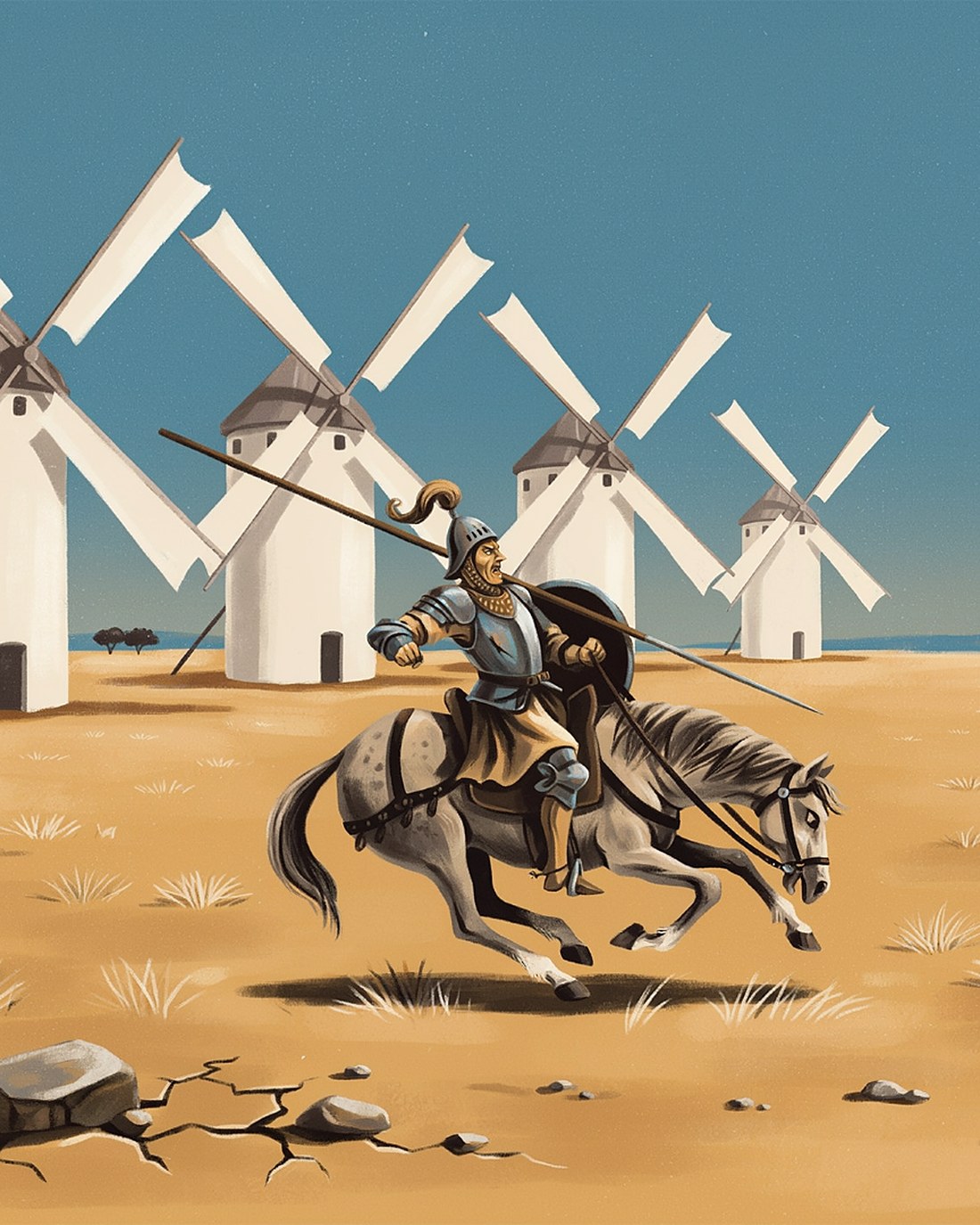
Tilting at windmills
In Cervantes' Don Quixote, published in 1605 and often called the first modern novel, the old knight charges a row of windmills he is sure are giants. The phrase tilting at windmills, for fighting imaginary enemies, comes straight from it. Every Spaniard knows the scene.
Say it: Don Quijote (don kee-HOH-teh)
The soul called duende
Flamenco, the song, guitar and dance of Andalusia, is not choreography so much as raw feeling. Spaniards call the goosebump moment, when a performer truly catches fire, duende, a kind of soul that cannot be faked. Admire it aloud and you speak their language.
Say it: duende (DWEN-deh)
When Granada was Moorish
For nearly 800 years much of Spain was al-Andalus, under Muslim rule, and the Alhambra in Granada is its masterpiece, all fountains, arches and carved light. Understanding Spain as a meeting place of cultures, not just one, shows you see it clearly.
Good to know: al-Andalus lasted nearly 800 yearsSpaniards live out loud and late: long lunches, the sobremesa lingering at the table, dinner near midnight, the streets full of people. Join in rather than rush, and you will be treated like one of the family.
No links here, nothing to buy. This part is just to help you travel well.
Sources, and how this guide was checked
Last reviewedJul 2026, 13 of 13 dated items inside their review window
Last actually changedApr 2026see the record →
Not yet individually datedWe date this guide and the fees most likely to move, but the 4 per-place tourist tax rates on this page do not carry a check date yet. They are reviewed with the guide rather than on their own schedule, and putting each of them on one is work in progress.
What the last check foundSources added. Verified that Barcelona's tourist tax roughly doubled on 1 April 2026 (the regional Catalan rate plus the city surcharge now runs about 6 to 12 euros a person per night by category, capped at 7 nights, under-16s exempt, and the surcharge is set to keep rising to 2029), and that Spain's IVA refund for non-EU visitors has no minimum spend. The guide's figures are current.
- Barcelona City Councilthe Catalan parliament's 2026 increase to the tourist tax and the city surcharge
Our own judgmentThe daily cash share, tipping norms, and likely ATM behavior are our own estimate from experience, not an official figure.
How we checkHow every guide is researched, checked and dated
More money guides in Europe
If you are also weighing up nearby destinations, each guide covers cards, cash, ATMs and the fees to expect.














Going deeper on Spain
The money questions people ask on the ground.
Short, focused answers to the specific things that catch first-timers out in Spain.
- Tipping in SpainSpain is a light-tipping country. Prices include tax, staff earn a wage, and nobody expects a US-style 15 to 20%. A modest propina for good service is welcome but never required. Here is what you actually owe.
- Bringing your dog or cat to Spain.Spain is a popular EU destination for US pet owners, and there is nothing Spain-specific to fear at the border. It runs on the single EU pet-entry process: microchip, rabies in the right order, and an EU health certificate on a 10-day clock. No quarantine, no rabies titer. Here is what that means for Spain, and the local parts worth knowing.
- Spain's tourist tax, region by region.Unlike Italy or France, Spain has no national tourist tax. Whether you pay one depends entirely on the region: Barcelona and the Balearic Islands charge a real fee, while Madrid, Seville and the Costa del Sol charge nothing at all. Here is the 2026 map.
- Do I need cash in Spain, or can I use cards?Short answer: card for almost everything, a little cash for tapas bars and markets. Spain is firmly card-first, and contactless runs the day. The things to get right are the fee-heavy kiosk ATMs, the odd card minimum, and the dollar prompt.
- Spain's VAT refund (IVA), and what you get back.Spain charges 21% IVA, and it is unusually generous on refunds: there is no minimum spend, so even a small purchase qualifies. It runs digitally through DIVA, but operator fees mean the real refund is under the headline. Here is how it works.
- Staying connected in Spain.Spain is well covered where you will be, the cities, the coast, the islands, so the real decision is how you pay for data. For most US travelers an eSIM is far cheaper than the carrier day pass. Here is the math, and the few places signal drops.
- What does renting a car in Spain really cost?Spain is superb for a road trip, from Andalusian white towns to the northern coast, and renting is easy once you dodge two traps: a fuel policy designed to overcharge you, and a permit you must carry by law.
- Taxis and apps in Spain.How you get a ride in Spain depends on the city. In Madrid the apps work like home; in Barcelona a new law has effectively pushed visitors back to the black-and-yellow taxi. Here is what works where, and the two airport fares to know.
- Common money scams in Spain, and what they cost youSpain is a safe, card-friendly country, and the things that cost visitors money here are rarely dramatic. Most of it happens quietly, on a card terminal or at the bottom of a bill, and every one of them is easy to sidestep once you know the shape of it.
- Do you need a rail pass in Spain?Spain has quietly become the most competitive high-speed rail market in Europe, and that competition is the reason fares are low. A pass opts you out of most of it.
- What does getting sick in Spain cost a visitor?Spain is direct about this in a way few countries are: care is not free for visitors, even in a public hospital, and leaving a bill unpaid can bar your next trip in. The reassuring half of the story is what the bill actually looks like.
This is how Spain stands today.
Money rules move. We can let you know for free if that changes.