
True Trip Costs: Laos
before you go
- DoPlan the ticket before the trip, not the train
- DoUse an agent or buy in person the moment seats release
- DoFares: Agree before you get in
- CarryKip, in small notes
- WithdrawATMs: Low limits, a fee each time
- ExpectSerious care: Thailand, not Laos
That's the short version. Below: every fee we checked, what it all adds up to, and the traps we help you dodge.
No match. See all guides.
Money in Laos, sorted.
A calm, current plan for the money side of your trip: how much cash to carry, why ATMs need patience, and the local rules to know before you go.

What you can refuse to pay here
The room rate isn't the bill, and the sticker rate isn't the price. In Laos, your own bank's foreign-transaction and ATM fees alone can quietly cost a typical traveler about $42, and it's one of several fees you can refuse.
Money scorecard
Laos
- Ease of payingCash-first
- Cash dependenceCash-heavy
- Daily costBudget
- Getting aroundHonest taxis
- CurrencyVolatile
Every rating is our own judgment from the Laos guide, not a score.
See the full Laos guideLaos has introduced a digital arrival and departure card. Since September 2025 the free Lao Digital Immigration Form is filed online before you travel, at the official portal immigration.gov.la, for a QR code at the border. It is rolling out at the main international entry points, the airports at Vientiane, Luang Prabang and Pakse and the first Lao-Thai Friendship Bridge, and not yet every crossing. It is free and separate from the e-visa, and Laos wants it on departure as well as arrival.
The three things people ask
Will my card work? Do I need cash? Are ATMs easy?
The quick read for a first trip.
Your card
Rarely accepted
Cards work only at bigger international hotels and some upscale restaurants and shops in Vientiane and Luang Prabang, often with a 2 to 3% surcharge. Apple Pay and Google Pay are not widely supported. Everywhere else is cash, so treat a card as a backup, not your main way to pay.
Check yours →Cash
Yes, every day
The kip is the everyday currency for street food, markets, tuk-tuks, guesthouses and small shops. Carry small notes for daily spending, since vendors often cannot change the largest 100,000 kip note. US dollars and Thai baht are handy as backup, but you will get a worse rate spending them.
How much to bring →ATMs
Low limits, real fees
Machines in the cities and tourist towns take Visa and Mastercard and dispense kip, but the per-withdrawal limit is low, often 1 to 2 million kip (roughly 45 to 90 dollars), with a 20,000 to 40,000 kip fee on top of your bank's. Plan several withdrawals, or step inside a BCEL branch to take out more for the same fee.
See ATMs in Laos →(opens in a new tab)Cash or card
Day to day, Laos leans heavily on cash.
A rough feel for everyday spending. Cards and QR climb a little at big hotels and tourist restaurants in Vientiane and Luang Prabang, but almost everything else, street food, markets, tuk-tuks, guesthouses and anywhere rural, is cash in kip. Keep small notes on you and pull more than you think you need.
See what the trip really costs →Your money plan
Four steps and you're set.
Before you go
- Get a no-foreign-fee debit card for cash. Charles Schwab refunds ATM fees worldwide, which suits Laos and its per-withdrawal fees well; Wise and Revolut are low-fee.
- Bring a little clean US dollars or Thai baht as backup, and a Visa or Mastercard for the few places that take cards.
- Sort your e-visa at the official site or plan a visa on arrival, and complete the free online Lao immigration form before you fly.
- Tell your bank you are traveling so your card is not blocked on arrival.
At the airport
- Have clean US dollars or Thai baht ready for the visa on arrival fee, plus two passport photos.
- Pull your first kip from a bank ATM and decline any offer to convert to dollars.
- Change only a small amount at the airport counter; rates are better in town.
Day to day
- Cash in kip for almost everything; keep small notes handy.
- Use a card only at bigger hotels and upscale spots, and expect a small surcharge.
- Always choose kip on any card terminal or ATM screen.
- Because ATM limits are low, withdraw in the largest chunk your machine allows, or use a bank branch.
A golden rule
- Always pay in kip, never in dollars. Choosing your home currency (dynamic currency conversion) quietly adds a poor rate on top of any fee.
- This is true at shop terminals and at ATMs alike, and it matters even more where withdrawals already carry a fee.
Staying connected
Will my phone work here? And what will it cost?
Yes in Vientiane, Luang Prabang, Vang Vieng and the main towns and roads, with 4G and some 5G. Coverage thins quickly in the mountains and remote valleys, so download maps before you head off the main routes. The cost is where people get caught out, and on most US plans it lands in one of two buckets.
Your plan may already include it
Often, do nothing
Some US plans include slow data abroad at no extra cost. If that is you, the honest move is to leave it alone.
we earn nothing
Or it charges quietly, after the fact
The bill lands later
On pay-per-use plans the cost runs in the background while you travel, and the charge can show up weeks after you are home. Forgetting to switch off data roaming is the classic one. For a week or more, an eSIM is usually cheaper and keeps you in control.
Check what your own carrier charges before the trip, not after.
If an eSIM is the cheaper call, Nomad covers Laos.
Get your Nomad eSIM→(opens in a new tab)we may earn a commissionMedical cover
The one cost with no price tag.
This is the one cost with no price tag, and it can be the largest on the page. Most US health plans and Medicare cover little or nothing abroad, so a serious illness or evacuation is paid up front. How medical costs work abroad, country by country →
First, you may not need to buy anything.
A cheap trip close to home, or a premium card that already includes emergency medical and evacuation, may mean you need nothing here. Check your card first. Saying that costs us the commission, and it is still the right call.
How much cover matters here
Strong care can sit a long way from where you are traveling and an evacuation is a genuine possibility, so this is one to weigh seriously for a trip here.
If you do want cover, this is what it is for: the evacuation and the up-front hospital bill, the part no card limit is meant to absorb.
Enough for most trips
Faye, or a comparable whole-trip policy
Bundles trip protection with emergency medical, which is enough cover for most travelers on a typical trip.
The deeper end
A dedicated travel-medical plan built for serious care and evacuation abroad
Stronger on medical care and evacuation, for a remote or higher-risk trip where that is the real exposure.
If it happens
Call it first, then call your insurer's 24/7 assistance line, which is what confirms payment and arranges an evacuation. 1195 is the ambulance line, with 1191 for police, 1190 for fire and 1192 for the tourist police. Care outside Vientiane is very limited and serious cases are often moved to Thailand, so travel insurance that covers medical evacuation matters here. The US 911 number does not work.
TrueTripCosts explains the gap and points to options. It does not set your coverage amounts or act as your insurance advisor, and every policy carries its own exclusions, so read them before you buy. Emergency number checked Jul 2026. Confirm the current number before you travel, as local lines can change.
Currency basics
The kip, in plain terms.
Quick conversion
About 22,000 kip to $1 in mid-2026, though the rate moves, so check it. A quick gut check: drop three zeros and roughly halve, so 100,000 kip is about 4 to 5 dollars. The largest note, 100,000 kip, is worth under 5 dollars.
Carry small notes
Notes run up to 100,000 kip, and vendors often cannot change the biggest one, so keep a stack of smaller notes for tuk-tuks, street food and markets. The kip is a closed currency you cannot use abroad, so spend it down before you fly home.
Low ATM limits and fees
Bank ATMs dispense kip but cap most withdrawals at 1 to 2 million kip, roughly 45 to 90 dollars, and charge 20,000 to 40,000 kip each time on top of your bank's fee. Plan several pulls, or withdraw more inside a BCEL branch for the same fee.
Tipping is not expected
Laos is not a tipping culture, so there is no set percentage. Rounding up or leaving small change for good service is a kind gesture rather than an obligation, and it is always welcome. See the tipping section below.
Real exchange rate
What your money is really worth here.
This is the mid-market rate, the one the banks trade at and the yardstick every other rate is measured against. Your card lands a little below it, and if a screen ever offers to bill you in dollars, that is worse again. So this is the number to expect, and how you spot a bad one.
1 US dollar is about 21,900 LAK
Taxes and refunds
What is in the price, and why there is nothing to reclaim.
Two things worth knowing. Laos charges a 10% VAT on most goods and services, and it is normally built into the price you see, so the number on the tag or menu is what you pay. At bigger hotels and restaurants you may instead see VAT added on top of a net rate, sometimes with a service charge of around 10%, so ask whether a quoted price is all in if it matters. Second, there is no tourist VAT refund in Laos, so there is nothing to claim back at the airport; the tax is simply part of the price.
That covers what a government adds. What you can still change is what the room itself costs, and that comes down to the booking moment: see how to pay less on hotels.
Fees and taxes to double-check
The numbers most likely to change.
These are the fees and taxes that move on political timelines, so we track each one on its own. Every line shows the amount, whether it is in effect yet, the date we last checked it, and a primary source where a clean one exists.
Laos tourist visa (30 days, US citizens)
About $40 as a visa on arrival at the airport, or roughly $50 via the official e-visa, plus two passport photos and the fee in clean US dollars or Thai baht. A free online Lao immigration form is also required before arrival.
Before you book: passports, the six-month rule and whether you need a visa. Not a US citizen, or connecting through Europe? The rules can differ, and even a layover can need its own visa. See our passports and visas guide →
Watch out for
The small traps that catch first-timers.
Tipping
Not expected, always welcome.
Laos is not a tipping culture, so there is no set percentage and no one expects it. Rounding up a tuk-tuk fare, leaving small kip notes after a good meal, or tipping a guide who looked after you well are all kind gestures rather than obligations, and they are genuinely appreciated given local wages. Some upscale hotels and restaurants add a service charge already, so check the bill before adding more. Tip in kip where you can, and hand it over directly.
Common questions
Quick answers.
Do I need cash in Laos?
Yes, every day. Laos is a cash-first country, and the kip is needed for street food, markets, tuk-tuks, guesthouses and most daily life. Cards work only at bigger hotels and a few upscale spots in Vientiane and Luang Prabang.
What is the exchange rate for the Lao kip?
Around 22,000 kip to the US dollar in mid-2026, though the kip has seen high inflation and the rate moves, so check a current figure before you travel. It is a high-denomination currency, so expect to carry thick stacks of notes.
How much can I withdraw from an ATM in Laos?
Not much at once. Most bank ATMs cap a single withdrawal at about 1 to 2 million kip, roughly 45 to 90 dollars, and charge 20,000 to 40,000 kip on top of your own bank's fee. Plan several withdrawals, or step inside a BCEL branch, where you can often take out more for the same fee.
Can I use US dollars or Thai baht in Laos?
Sometimes, in tourist areas of Vientiane, Luang Prabang and near the Thai border, and they are the only currencies accepted for the visa on arrival. But you will get a worse rate spending them than paying in kip, and small purchases and rural areas are kip only. Bring some clean, newer notes as a backup.
Should I pay in kip or dollars on a card machine in Laos?
Always kip. If a card terminal or ATM offers to charge you in dollars, decline it; that dynamic currency conversion adds a poor rate on top of any fee, and it stings more here because withdrawals already carry one.
Do US citizens need a visa for Laos?
Yes. You can get a visa on arrival at major airports and land borders for about 40 dollars, or apply for an e-visa in advance at the official site for roughly 50 dollars, both for a 30-day stay. Bring two passport photos and the fee in clean US dollars or Thai baht, and complete the free online Lao immigration form before you arrive.
Do you tip in Laos?
It is not expected and there is no set percentage. Rounding up or leaving small kip notes for good service is appreciated but never required. Some upscale places add a service charge already, so check the bill first.
Can I take leftover kip home?
It is best not to try. The kip is a closed currency that you cannot exchange outside Laos, so spend it down or change it back before you leave the country.
How much cash should I bring for a week in Laos?
For two mid-range travelers, very roughly 350 to 500 US dollars in day-to-day spending across a week beyond your hotel, most of it withdrawn as kip in several ATM visits. Adjust for your style and how remote your route is.
What will your trip really cost?
Name where you are going. We will show you what nobody quotes.
For instance, right now
 ColombiaHotels charge 19% IVA, but as a foreign tourist you are exempt, and about half try to add it anyway.
 JapanThe world's most high-tech country is still cash-first, and most bank ATMs refuse US cards.
 CzechiaCzech law gives you three hours to cancel a bad currency exchange and get your money back, on amounts up to 1,000 EUR.
 GreeceGreece's climate fee charges an Airbnb-style rental about 8 EUR a night against 2 for a budget hotel.
 El SalvadorThe country that made Bitcoin legal tender?
 CambodiaThe US dollar is Cambodia's everyday currency, and ATMs hand you crisp $100 bills nobody can break.
 TurkeyUS citizens need no visa and no e-visa for Turkey, scrapped in 2023.
 ItalyMost Italian restaurants add a coperto, a per-person cover charge of commonly 2 to 3 euros, before you have ordered anything.
The one thing most people get wrong about Laos
Guide checked Jul 2026You budget for the Laos-China railway as just another train fare.
Getting a seat is harder than the ride: there is no working online ticket site for foreigners, and trains sell out within minutes of release.
What to doPlan the ticket before the trip, not the train, and use an agent or buy in person the moment seats release.
Ticketing practice moves. Re-verify each season.
How to actually get a Laos-China railway ticketEverything we checked
What Laos actually charges you, in one place.
6 things we verified for Laos, grouped by the kind of thing they are. The numbers are below; this is the shape of them.
fees nobody quotes
money you keep
traps to dodge
timing
The number
What you'll really spend in Laos.
Your flights if you want them counted, your room, your on-the-ground spending, the two fees most US cards add without telling you, and Laos's tourist tax. One number, nothing waiting on the statement. No bank to pick, no sign-up, nothing saved.

Optional. Enter your round trip fare per traveler to fold flights into the total.
Total trip realistically somewhere between $0 and $0.
Getting thereflights, and what the border costs
Watch out for
Prepare ahead
These carry no dollar figure by design: each is named because it is real, and there is nothing honest to price here.
Departure tax is not a separate line here. Where a country charges one it is collected inside your airfare, so it is already in the flight figure, and adding it again would count it twice.
On the ground detailyour room, your days, and how much of it is cash
Whether at an ATM or a card terminal in a shop or restaurant, always choose to be charged in the local currency, not dollars. Paying in dollars (called dynamic currency conversion) lets the machine set its own, worse, exchange rate on top of any fee.
Fees nobody quotes youthe part that lands on the statement weeks later
What you'll pay
Plus the one-off entry charge, which sits in Getting there above with the flights, because it is per person rather than per night.
What you can refuse, and what the lookalike sites charge, is set out under Costs nobody tells you about below, with the two figures kept apart from these ones.
Costs nobody tells you about
Most of it you can keep. Here is every dollar of it.
Every one of them, and how to avoid it6 items
Two of these are money you hand over by default; the rest is money you keep by knowing. Each is its own line.
What you'll pay unless you act
- Your own bank's foreign feeswhat the fees above come toMost US cards add a percentage on what you buy and on the cash you pull, plus a few dollars per ATM withdrawal. Nothing about that is a cost of the trip; it is a cost of the card you happened to bring.A no-foreign-fee card takes both fee lines above to zero.The cards that do not charge it
- Paying in dollars at the terminalabout 3 to 8%on what you cardDynamic currency conversion lets the machine set its own rate on top of any fee, and it runs about 3 to 8 percent on whatever you put on the card. It is the single easiest charge on this page to refuse, and it costs nothing to say no.Choose LAK every time, at a till and at an ATM.How to decline it
- The airport or hotel exchange deskExchange counters make their money on the spread rather than on a stated fee, which is why we publish no percentage for it: it moves by counter, by hour and by note. The rule is what is reliable, not the number.Withdraw from a bank ATM instead, and never change cash at the airport.Getting cash here
What we'll help you dodge
- Paying for the Lao Digital Immigration Form (LDIF)freeon the official siteIt is free on the official government site, and it is mandatory, which is exactly why lookalike sites buy the search terms. We publish no figure for what they charge because none is sourced for Laos, but anything above nothing is too much.File it yourself at www.immigration.gov.la. It takes minutes.Every form, and its real site
- Reseller markup on the entry chargeThe charge itself is unavoidable. Paying an agent on top of it is not, and the sites that rank above the official one are agents. We publish no figure for the markup because it varies by reseller.Apply on the official government portal, linked in Getting there above.The official source for this charge
- The open-ended tuk-tuk fareA fare left open until you arrive is a negotiation, not a price, and the per-person-versus-per-vehicle mix-up is the most common one.Agree the price out loud before you get in, confirm it covers the whole trip and any waiting time, and check whether it is per person or for the vehicle.How taxis work here
Where these numbers come fromevery assumption, and its limitssources
These are the assumptions behind the number. Change the room price, nights, travelers, or travel style above, and every line here moves with them.
- Hotel
- Daily spending
- Flights
- Cash vs card
- ATM withdrawals
- Foreign fee
- The range
- Tourist tax
Rough guide, not a quote. The percentage here is a blended stand-in for a typical US card's foreign fee, not your exact rate. The real number moves with the card you carry: one no-foreign-fee card can cover both sides, while a plain rewards credit card only removes the fee on what you buy, and cash still costs a little unless that card also waives ATM and foreign-cash fees. A debit card, or accepting the "pay in dollars" (dynamic currency conversion) offer at a till or ATM, can push it higher. Rates checked Jun 2026 and rounded.
How we check and date every figureLaos, TTC-ed
truetripcosts.comWhat this assumes
Tips are already inside the daily spending figure, never added on top.
Not sure which card to bring? See my pick for Laos.
Already carry a card with no foreign transaction fee? Then you are set for Laos, and can skip this. There is nothing to buy.
If you are getting a card for Laos, this is the pairing I would pick: a no-foreign-fee credit card for spending, and a fee-free ATM debit card for cash. We earn nothing on these today. Always confirm the current fee with the issuer before you apply. Checked Jun 2026.
Capital One charges no foreign transaction fee on any of its cards.
No foreign transaction fee
Fee-free ATM cash worldwide

Want one account that holds and spends in the local currency? A different job from the three above, and the one I reach for abroad. It is free to open; you can create a virtual card in the app and add it to your phone wallet in minutes, without waiting for the physical card; and you can convert US dollars into the local currency inside the account before you travel, then spend from that balance. Wise uses the mid-market rate plus a small conversion fee (around 0.4% and up), with no flat foreign fee.
The three picks above pay us nothing, and their tags say so. Wise is the only option here that can earn us a commission, and its tag says that too. Paid or not, the pick is still the pick.
Before you fly
At least 14 countries now make you file a form online before you fly. 13 of them are free. One really does charge, and it is not the one you would guess.
That includes Laos, where the Lao Digital Immigration Form (LDIF) is one of them. The filings are new, obscure and mandatory, which is exactly the combination a scam needs: search for any of them and the paid lookalikes come up before the government site does, because the real ones do not buy ads.
See every form we can source, with the official address for eachWhen to go
Cheaper and busier months in Laos.
The month you pick moves the budget as much as the country does. Here is the shape of Laos's year, with no price attached to it, because an honest one does not exist.
- Busy and pricey
- In between
- Cheaper and quieter
- Cheaper and quieter
- May to Sep
- What drives the peak
- The cool dry season, Christmas and New Year in Luang Prabang, and Lao New Year in mid-Apr
Medium confidence. The seasons are well established, though the money side of them is partly our own inference.
See all 59 countries compared on the when to go pageTravelers, not touristsA little Lao goes a long way
A little Lao goes a long way
Lao is written in its own graceful, rounded script and no one expects you to read it, but a warm Sabaidee with a small bow and a story or two mark you as a guest rather than a tourist. Laos moves at its own gentle pace, and a little patience and courtesy are met with real warmth.
Say a few words
Tip: Greet people with a nop, palms pressed together at the chest with a small bow, the Lao version of the Thai wai; it is a lovely thing to return. As across the region, the head is sacred and the feet are lowest, so do not touch anyone's head or point your feet at people or Buddha images. Dress modestly at temples, cover shoulders and knees, and if you watch the dawn alms round, keep a respectful distance and stay quiet.
Know a story
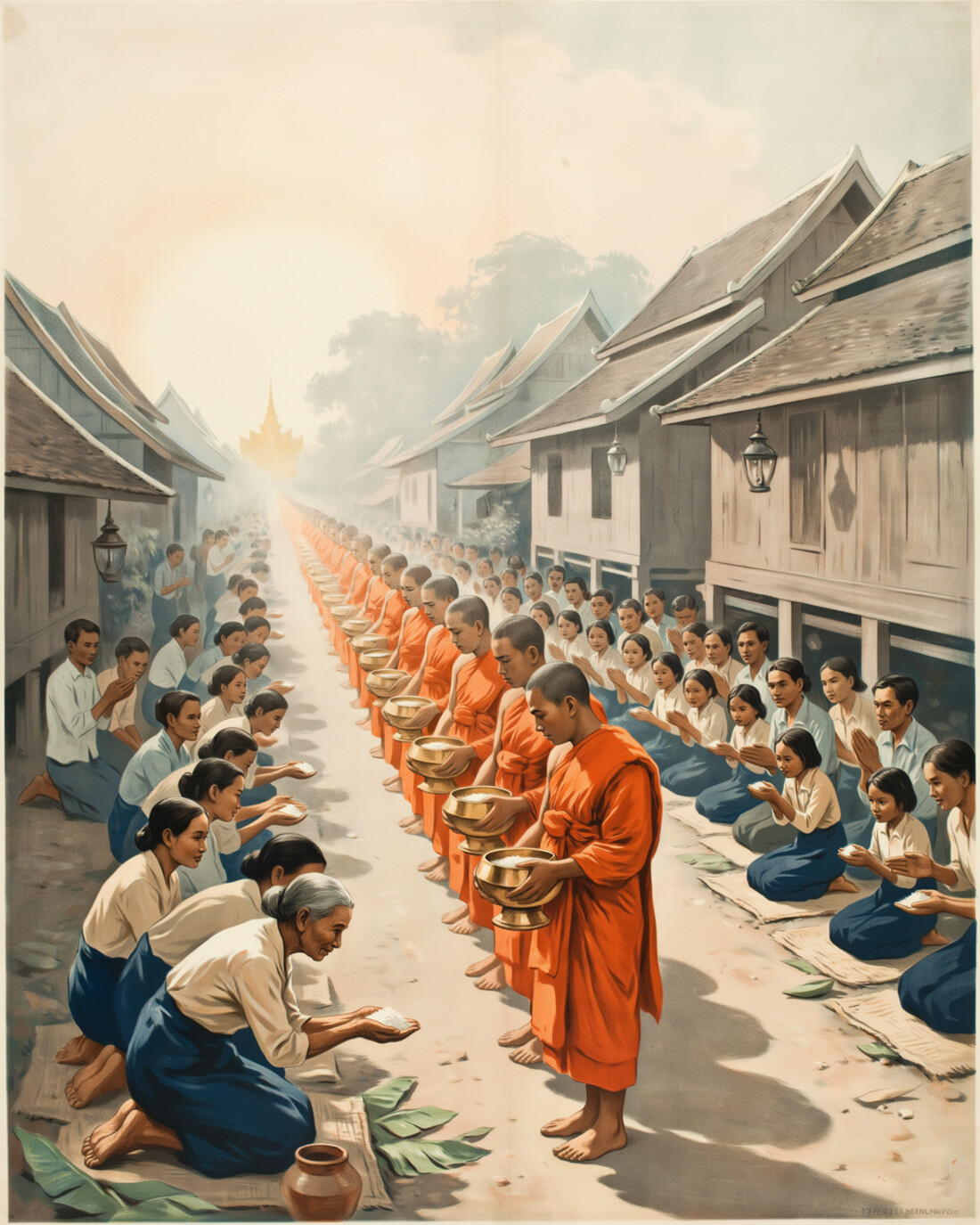
The quiet ritual of dawn
Each morning before sunrise in Luang Prabang, hundreds of barefoot monks walk in a long silent line to receive offerings of sticky rice from kneeling residents, a ceremony called Tak Bat that has gone on for centuries. It is calm, wordless and deeply moving. Watch quietly from a distance, without flash or fuss, and you glimpse the soul of Lao Buddhism.
Good to know: the dawn alms round is called Tak Bat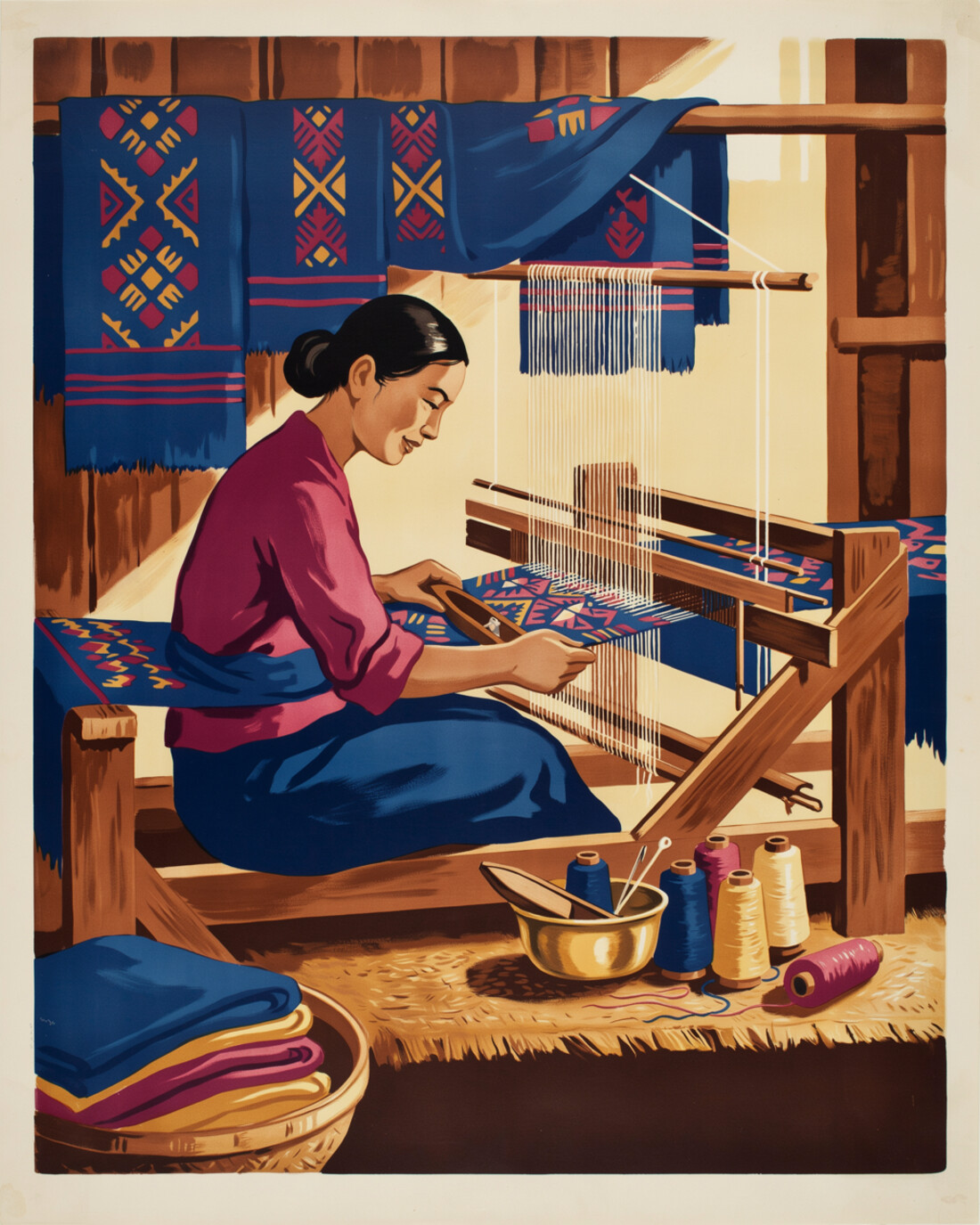
Stories woven in silk
Lao women have woven silk on wooden looms for generations, and the intricate patterns, dragons, diamonds and ancestral motifs, carry meaning passed down through families. A single fine piece can take weeks, and the craft is a point of deep pride, worn at weddings and festivals across the country. Watch a weaver at work and you see patience turned into art.
Good to know: handwoven Lao silk often marks weddings and festivals
Life along the Mekong
The Mekong is the thread that ties Laos together, and long wooden boats still carry people and goods between riverside villages framed by forested limestone peaks. A slow journey upriver, past fishermen and stilt houses in the golden light, is one of the calmest things you can do in Southeast Asia. The river sets the rhythm of Lao life.
Good to know: the Mekong runs the length of the countryLao people are gentle, unhurried and quick to smile, proud of their Buddhist faith, their handwoven silk and a way of life the country calls sabai, an easy contentment. Return a nop, take things slowly, show respect at the temples, and Laos opens up warmly.
No links here, nothing to buy. This part is just to help you travel well.
Sources, and how this guide was checked
Last reviewedJul 2026, 9 of 9 dated items inside their review window
Last actually changedSep 2025see the record →
What the last check foundSources added on first publish. Confirmed with PwC's tax summary that Laos charges a standard 10% VAT and has no separate tourist tax or visitor refund. Verified the tourist visa on the official Lao e-visa portal, with a visa on arrival also available, and the separate, free online immigration form. The kip's rate, around 22,000 to the dollar in mid-2026 after a rough few years, moves, so the live panel below and a fresh check both matter.
- PwC Worldwide Tax SummariesLaos's standard 10% VAT
- Lao e-Visa (official government portal)the tourist e-visa, entry points and fee
- Trading Economicsthe Lao kip's exchange rate against the US dollar
- UK Foreign, Commonwealth and Development Officeemergency numbers and help in Laos
Our own judgmentThe daily cash share, the tipping norms, and the ATM limit and fee ranges are our own read from recent traveler and bank reports, not a single official table. Treat them as a planning guide and confirm anything critical before you travel.
How we checkHow every guide is researched, checked and dated
More money guides in Asia
If you are also weighing up nearby destinations, each guide covers cards, cash, ATMs and the fees to expect.








Going deeper on Laos
The money questions people ask on the ground.
Short, focused answers to the specific things that catch first-timers out in Laos.
- Do I need cash in Laos, or can I use cards?Cash, and plenty of it. Laos is the most cash-dependent country we cover, and the friction is not acceptance, it is the ATM: low limits and a fee every time. A little planning fixes it.
- Tipping in LaosLaos is not a tipping culture, so there is no percentage to remember and nobody is waiting for one. In tourist areas a small tip has become normal and is genuinely appreciated, which is a different thing from expected.
- Taxis, tuk-tuks and ride apps in LaosMetered taxis barely exist here. Getting around means tuk-tuks, shared songthaews and, in the bigger towns, a local ride app that takes the negotiation out of it. One habit covers the rest: settle the fare first.
- Booking the Laos-China Railway, and why that is the hard partThe Laos-China Railway is fast, comfortable and the obvious way to move between Vientiane and Luang Prabang. Getting a seat is what catches visitors out, because the booking and payment side was not built for anyone without a local phone number. Here is how it actually works.
- Do US citizens need a visa for Laos?Yes, and the online route is the expensive one. Laos charges roughly ten dollars a person more to apply in advance than to buy the visa at the airport counter, which is the reverse of the usual advice. Here is what each costs, and what the cheaper one wants from you.
- Staying connected in Laos.Laos sells data for almost nothing and has less of a network to sell it on than its neighbors. The right move is a cheap local SIM plus the habit of downloading things before you leave a town.
- What does getting sick in Laos cost?Laos has the starkest medical geography of anywhere we cover. Serious care is not in the country, it is across the river in Thailand, and the honest planning question is not what a doctor charges but how you get across and how fast.
This is how Laos stands today.
Money rules move. We can let you know for free if that changes.