True Trip Costs: Singapore
before you go
- DoLearn the two symbols before you order
- DoFrom Changi: The MRT is cheap and fast
- CarryCash for: Hawker stalls and small vendors
- ExpectNett is the real price, ++ is not
- ExpectSubsidy for you: None at all
- ExpectTipping: Not customary
That's the short version. Below: every fee we checked, what it all adds up to, and the traps we help you dodge.
No match. See all guides.
Money in Singapore, sorted.
A calm, current plan for the money side of your trip: why a tap of your card covers almost everything, including the trains and buses, the small cash worth carrying for hawker food, the fee-free way to get dollars, and the 9% GST you can claim back on what you buy to take home.
What you can refuse to pay here
The room rate isn't the bill, and the sticker rate isn't the price. In Singapore, dynamic currency conversion alone can quietly cost a typical traveler about $85 to $227, and it's one of several fees you can refuse.
Money scorecard
Singapore
- Ease of payingEasy
- Cash dependenceLight cash use
- Daily costExpensive
- Getting aroundHonest taxis
- CurrencyStable
Every rating is our own judgment from the Singapore guide, not a score.
See the full Singapore guideTwo small things are current for 2026. Singapore's GST holds at 9%, with Budget 2026 confirming no further rise, so the rate baked into the prices you see is unchanged. And at the border there is no passport stamp anymore: you file the free SG Arrival Card online within three days of arrival, health declaration included, and receive a digital e-Pass by email. Neither costs much attention, but both are worth knowing before you fly.
The three things people ask
Will my card work? Do I need cash? Are ATMs easy?
The quick read for a first trip.
Your card
Works almost everywhere
Visa and Mastercard are taken at hotels, malls, restaurants, taxis and most hawker stalls, and you can tap your contactless card or phone straight onto the gates of the MRT and buses through the SimplyGo system, with no card to buy and no sign-up. Amex is less widely accepted, so lead with a Visa or Mastercard. The soft spots are a handful of hawker stalls and wet-market vendors that take cash only.
Check yours →Cash
A small backup
You rarely need it, but keep a few small Singapore dollar notes for the hawker stalls, kopitiams and wet-market vendors that are cash only. Get dollars from a bank ATM rather than an airport exchange counter, and draw only what you will use.
How much to bring →ATMs
Easy and everywhere
ATMs are on nearly every corner and inside the malls, run by banks like DBS and POSB, OCBC and UOB, and foreign Visa and Mastercard cards work in them without fuss. Withdrawal fees are modest. Decline any offer to charge you in US dollars and always choose Singapore dollars so your own bank handles the exchange.
See ATMs in Singapore →(opens in a new tab)Cash or card
About as cashless as travel gets, with a little cash for the hawkers.
A rough feel for everyday spending. Cards and phones cover almost everything, from hotels and restaurants to shops, taxis and the trains and buses. Cash is a small backup for the hawker stalls and wet-market vendors that are cash only, and a few dollars usually does it.
See what the trip really costs →Your money plan
Four steps and you're set.
Before you go
- Bring a no-foreign-fee Visa or Mastercard, plus a backup from a different bank. Amex is less widely accepted here, so do not rely on it alone.
- Add your card to your phone wallet (Apple Pay, Google Pay or Samsung Pay). It works to tap onto the trains and buses and at almost every till.
- File the free SG Arrival Card online within three days before you arrive. It is mandatory, includes a short health declaration, and is not a money charge. Use only the official ICA site or app, never a paid third party.
- Planning to shop? For the GST refund you must show your passport at the shop when you buy and carry the goods out with you, so keep it handy.
At Changi
- Skip the exchange counters. If you want cash, pull Singapore dollars from a bank ATM in the arrivals hall, and decline 'convert to US dollars.'
- To reach the city, just tap your card or phone onto the MRT gate. Paper single tickets are gone, so tap in and tap out.
- Only riding a lot? Consider a Singapore Tourist Pass or an EZ-Link card, but for a few trips a day, tapping your own card is usually cheaper.
- Set up an eSIM before you land. Coverage is excellent, and you will want data for maps and the Grab taxi app, though not for paying.
Day to day
- Tap your card or phone for almost everything, and choose Singapore dollars every time.
- Tap the same card or phone at the MRT and bus gates, and remember to tap off, or you pay the maximum fare.
- Keep a few small notes for hawker stalls, kopitiams and wet markets that are cash only.
- Shopping something to take home? Ask for the GST refund (eTRS) at a Tax Free shop when you spend at least S$100.
A golden rule
- Always pay in Singapore dollars, never in US dollars. Choosing your home currency (dynamic currency conversion) quietly adds a few percent on card terminals and ATMs.
- Do not tip. It is not expected, and restaurants and hotels usually add a 10% service charge already, the ++ after the price.
Staying connected
Will my phone work here? And what will it cost?
Among the best anywhere. Singapore has fast, dense 4G and 5G across the whole island, and Changi and much of the city offer free public WiFi. The three carriers are Singtel, StarHub and M1, and a prepaid SIM is cheap, but for most visitors an eSIM from Airalo, Nomad or a similar provider is the easy route. Your US plan may include some roaming, so check the rate before you rely on it. You do not need mobile data to pay by card, but you will want it for maps and the Grab taxi app. The cost is where people get caught out, and on most US plans it lands in one of two buckets.
Your plan may already include it
Often, do nothing
Some US plans include slow data abroad at no extra cost. If that is you, the honest move is to leave it alone.
we earn nothing
Or it charges quietly, after the fact
The bill lands later
On pay-per-use plans the cost runs in the background while you travel, and the charge can show up weeks after you are home. Forgetting to switch off data roaming is the classic one. For a week or more, an eSIM is usually cheaper and keeps you in control.
Check what your own carrier charges before the trip, not after.
If an eSIM is the cheaper call, Nomad covers Singapore.
Get your Nomad eSIM→(opens in a new tab)we may earn a commissionMedical cover
The one cost with no price tag.
This is the one cost with no price tag, and it can be the largest on the page. Most US health plans and Medicare cover little or nothing abroad, so a serious illness or evacuation is paid up front. How medical costs work abroad, country by country →
First, you may not need to buy anything.
A cheap trip close to home, or a premium card that already includes emergency medical and evacuation, may mean you need nothing here. Check your card first. Saying that costs us the commission, and it is still the right call.
How much cover matters here
Care in the main cities is good, but costs add up and reaching top care from a remote spot takes time, so it is worth a real look for a trip here.
If you do want cover, this is what it is for: the evacuation and the up-front hospital bill, the part no card limit is meant to absorb.
Enough for most trips
Faye, or a comparable whole-trip policy
Bundles trip protection with emergency medical, which is enough cover for most travelers on a typical trip.
The deeper end
A dedicated travel-medical plan built for serious care and evacuation abroad
Stronger on medical care and evacuation, for a remote or higher-risk trip where that is the real exposure.
If it happens
Call it first, then call your insurer's 24/7 assistance line, which is what confirms payment and arranges an evacuation. 995 reaches an ambulance or the fire service, and 999 is the police. Both are free and answer around the clock. If you dial 911 out of habit on a US phone, it is routed to 999 automatically. The public emergency ambulance is free for a genuine emergency, while a non-emergency call-out is charged.
TrueTripCosts explains the gap and points to options. It does not set your coverage amounts or act as your insurance advisor, and every policy carries its own exclusions, so read them before you buy. Emergency number checked Jul 2026. Confirm the current number before you travel, as local lines can change.
Currency basics
The Singapore dollar, in plain terms.
Quick conversion
Singapore uses the Singapore dollar, written S$. At about 1.29 to the US dollar in mid-2026, S$10 is roughly 8 dollars and S$100 about 78. Notes come in 2, 5, 10, 50 and 100 dollars, with 1 dollar and smaller amounts in coins. Prices already include the 9% GST, so the figure on the tag is what you pay, before any service charge on a restaurant or hotel bill.
Cards rule, cash is a backup
Visa and Mastercard work almost everywhere, with Amex less universal. You can go days without cash, but a handful of hawker stalls and wet-market vendors take cash only, so carry a few small notes as backup and draw them from any bank ATM.
One tap runs transit
You do not need a separate transit card. Tap a contactless Visa or Mastercard, or your phone, straight on the MRT and bus gates through SimplyGo, with a small foreign-card fee of about S$0.60 for each day you ride. You can instead buy an EZ-Link card or a Singapore Tourist Pass, and single paper tickets are gone, though buses still take cash for a fare.
No tipping
Singapore is not a tipping culture, and it is not expected. Restaurants and hotels usually add a 10% service charge already, the ++ you see after a price, so nothing more is needed. At hawker stalls and taxis you simply pay the amount, and rounding up a fare is a friendly touch, not a rule.
Real exchange rate
What your money is really worth here.
This is the mid-market rate, the one the banks trade at and the yardstick every other rate is measured against. Your card lands a little below it, and if a screen ever offers to bill you in dollars, that is worse again. So this is the number to expect, and how you spot a bad one.
1 US dollar is about 1.29 SGD
Taxes and refunds
A 9% GST you can claim back on the things you shop for.
Singapore keeps tax simple for a visitor. There is no nightly tourist or bed tax. The 9% GST is already included in the price you see, and restaurants and hotels usually add a 10% service charge on top, the ++ after a price (a price marked nett is all-in). The win worth acting on: as a tourist you can claim the GST back on goods you buy to take home, through the Tourist Refund Scheme. Spend at least S$100 including GST at a shop showing a Tax Free or GST Refund sign (you can add up to three same-day receipts from the same shop to reach it), and show your passport when you buy. Then, before you fly out of Changi or Seletar, scan your passport at an eTRS self-help kiosk and choose your refund to a card, to Alipay, or as cash. It covers goods only, not services, hotel stays or anything used up here, and you must be leaving by air with the goods within two months. Keep them handy in case customs asks for a look. After the refund company's handling fee, you get back a little under the full 9%.
That covers what a government adds. What you can still change is what the room itself costs, and that comes down to the booking moment: see how to pay less on hotels.
Fees and taxes to double-check
The numbers most likely to change.
These are the fees and taxes that move on political timelines, so we track each one on its own. Every line shows the amount, whether it is in effect yet, the date we last checked it, and a primary source where a clean one exists.
GST (sales tax)
9%, already included in displayed prices, and held at 9% for 2026 with no rise announced
SG Arrival Card (SGAC)
Mandatory and free, filed online within three days before arrival, with a short health declaration
Before you book: passports, the six-month rule and whether you need a visa. Not a US citizen, or connecting through Europe? The rules can differ, and even a layover can need its own visa. See our passports and visas guide →
Watch out for
The small traps that catch first-timers.
Tipping
Don't tip, it is built in.
Singapore is not a tipping culture, and there is no awkwardness in not tipping. Restaurants and hotels usually add a 10% service charge to the bill already, shown as the ++ after a price, so you do not add anything more. At hawker centres and kopitiams you pay the stall directly and do not tip, and in taxis there is no tip, though rounding the fare up is a friendly touch. The rare exceptions where a small gesture is welcome are a high-end hotel porter or concierge who goes out of their way, or an excellent private guide on a longer tour. Otherwise, pay the amount on the bill or the meter and keep your wallet closed.
Common questions
Quick answers.
Do I need cash in Singapore?
Barely. Singapore is one of the most cashless places anywhere, and cards and phones cover almost everything, including the trains and buses. Carry a few small Singapore dollar notes as backup for the hawker stalls, kopitiams and wet-market vendors that are cash only, and draw them from any bank ATM as needed.
Can I use my card on the MRT and buses in Singapore?
Yes, and it is the easy way to travel. Tap a contactless Visa or Mastercard, or your phone, straight on the MRT and bus gates through the SimplyGo system, with no card to buy and no sign-up. There is a small foreign-card fee of about S$0.60 for each day you ride, and you must tap out as well as in, or you are charged the maximum fare.
Should I pay in Singapore dollars or US dollars?
Always Singapore dollars. If a card terminal or ATM offers to charge you in US dollars, decline; that dynamic currency conversion adds a few percent. Choosing Singapore dollars lets your card's network handle the exchange at a fair rate.
Can I get a GST refund on shopping in Singapore?
Yes. As a tourist you can claim back the 9% GST on goods you buy to take home, under the Tourist Refund Scheme. Spend at least S$100 including GST at a shop showing a Tax Free or GST Refund sign, show your passport when you buy, then scan your passport at an eTRS self-help kiosk at Changi or Seletar before you fly, and choose a refund to your card, to Alipay, or as cash. It covers goods only, not services or hotel stays, and you get back a little under the full 9% after the handling fee.
What does ++ mean on a menu or hotel price in Singapore?
It means the 9% GST and a 10% service charge are added on top. So a dish listed at S$10++ actually costs about S$12 once both are applied. A price marked nett already includes everything, with nothing more to add.
Do you tip in Singapore?
No. Tipping is not customary and not expected. Restaurants and hotels usually add a 10% service charge already, shown as the ++ after a price, so you do not add more. In taxis there is no tip, though rounding up the fare is a friendly gesture.
Do I need an SG Arrival Card for Singapore?
Yes. Everyone entering Singapore must file the free SG Arrival Card online within three days before arrival, including a short health declaration, and you receive a digital e-Pass by email. It is not a visa; US visitors can enter without a visa for up to 90 days. Use only the official ICA website or app, since paid third-party sites are not endorsed.
How much cash should I bring for a week in Singapore?
Very little on top of card spending. For most visitors a modest amount of small Singapore dollar notes across the week is plenty for hawker food and the odd cash-only stall, refreshed from a bank ATM as needed. Cards and phones handle the rest, including transit.
What will your trip really cost?
Name where you are going. We will show you what nobody quotes.
For instance, right now
 ColombiaHotels charge 19% IVA, but as a foreign tourist you are exempt, and about half try to add it anyway.
 JapanThe world's most high-tech country is still cash-first, and most bank ATMs refuse US cards.
 CzechiaCzech law gives you three hours to cancel a bad currency exchange and get your money back, on amounts up to 1,000 EUR.
 GreeceGreece's climate fee charges an Airbnb-style rental about 8 EUR a night against 2 for a budget hotel.
 El SalvadorThe country that made Bitcoin legal tender?
 CambodiaThe US dollar is Cambodia's everyday currency, and ATMs hand you crisp $100 bills nobody can break.
 TurkeyUS citizens need no visa and no e-visa for Turkey, scrapped in 2023.
 ItalyMost Italian restaurants add a coperto, a per-person cover charge of commonly 2 to 3 euros, before you have ordered anything.
The one thing most people get wrong about Singapore
Guide checked Jul 2026You read a Singapore menu price and add up what dinner will cost.
Two plus signs after a price mean 19% is still coming: 9% GST and a 10% service charge, added at the end. S$10++ is about S$12. A price marked "nett" already includes everything.
What to doLearn the two symbols before you order. Nett is the real price, ++ is not.
Everything we checked
What Singapore actually charges you, in one place.
7 things we verified for Singapore, grouped by the kind of thing they are. The numbers are below; this is the shape of them.
money you keep
traps to dodge
timing
The number
What you'll really spend in Singapore.
Your flights if you want them counted, your room, your on-the-ground spending, the two fees most US cards add without telling you, and Singapore's tourist tax. One number, nothing waiting on the statement. No bank to pick, no sign-up, nothing saved.
Optional. Enter your round trip fare per traveler to fold flights into the total.
Total trip realistically somewhere between $0 and $0.
Getting thereflights, and what the border costs
Watch out for
Prepare ahead
These carry no dollar figure by design: each is named because it is real, and there is nothing honest to price here.
Departure tax is not a separate line here. Where a country charges one it is collected inside your airfare, so it is already in the flight figure, and adding it again would count it twice.
On the ground detailyour room, your days, and how much of it is cash
Whether at an ATM or a card terminal in a shop or restaurant, always choose to be charged in the local currency, not dollars. Paying in dollars (called dynamic currency conversion) lets the machine set its own, worse, exchange rate on top of any fee.
Fees nobody quotes youthe part that lands on the statement weeks later
What you'll pay
What you can refuse, and what the lookalike sites charge, is set out under Costs nobody tells you about below, with the two figures kept apart from these ones.
Costs nobody tells you about
Most of it you can keep. Here is every dollar of it.
Every one of them, and how to avoid it6 items
Two of these are money you hand over by default; the rest is money you keep by knowing. Each is its own line.
What you'll pay unless you act
- Your own bank's foreign feeswhat the fees above come toMost US cards add a percentage on what you buy and on the cash you pull, plus a few dollars per ATM withdrawal. Nothing about that is a cost of the trip; it is a cost of the card you happened to bring.A no-foreign-fee card takes both fee lines above to zero.The cards that do not charge it
- Paying in dollars at the terminalabout 3 to 8%on what you cardDynamic currency conversion lets the machine set its own rate on top of any fee, and it runs about 3 to 8 percent on whatever you put on the card. It is the single easiest charge on this page to refuse, and it costs nothing to say no.Choose SGD every time, at a till and at an ATM.How to decline it
- The airport or hotel exchange deskExchange counters make their money on the spread rather than on a stated fee, which is why we publish no percentage for it: it moves by counter, by hour and by note. The rule is what is reliable, not the number.Withdraw from a bank ATM instead, and never change cash at the airport.Getting cash here
What we'll help you dodge
- Paying for the SG Arrival Cardfreeon the official siteIt is free on the official government site, and it is mandatory, which is exactly why lookalike sites buy the search terms. We publish no figure for what they charge because none is sourced for Singapore, but anything above nothing is too much.File it yourself at www.ica.gov.sg/enter-transit-depart/entering-singapore/sg-arrival-card. It takes minutes.Every form, and its real site
- Tipping on top of a service chargeA service charge is always added to the bill in Singapore, so a tip on top of it is paying for service twice. We put no figure on this one, because what you would have added is up to you.Read the bill first. Where the charge is on it, that is the tip.How tipping works here
- The sales tax you can claim backSingapore refunds sales tax to visitors on qualifying shopping, with the rate and any minimum spend set out in this guide. Most travelers never claim it, and we put no dollar figure on it, because it depends on what you buy.Ask for the tax-free form at the till, keep the goods unused, and claim on the way out.The rate and the minimum spend
Where these numbers come fromevery assumption, and its limitssources
These are the assumptions behind the number. Change the room price, nights, travelers, or travel style above, and every line here moves with them.
- Hotel
- Daily spending
- Flights
- Cash vs card
- ATM withdrawals
- Foreign fee
- The range
- Tourist tax
Rough guide, not a quote. The percentage here is a blended stand-in for a typical US card's foreign fee, not your exact rate. The real number moves with the card you carry: one no-foreign-fee card can cover both sides, while a plain rewards credit card only removes the fee on what you buy, and cash still costs a little unless that card also waives ATM and foreign-cash fees. A debit card, or accepting the "pay in dollars" (dynamic currency conversion) offer at a till or ATM, can push it higher. Rates checked Jun 2026 and rounded.
How we check and date every figureSingapore, TTC-ed
truetripcosts.comWhat this assumes
Nothing expected in tips here, so nothing is added for them.
Not sure which card to bring? See my pick for Singapore.
Already carry a card with no foreign transaction fee? Then you are set for Singapore, and can skip this. There is nothing to buy.
If you are getting a card for Singapore, this is the pairing I would pick: a no-foreign-fee credit card for spending, and a fee-free ATM debit card for cash. We earn nothing on these today. Always confirm the current fee with the issuer before you apply. Checked Jun 2026.
Capital One charges no foreign transaction fee on any of its cards.
No foreign transaction fee
Fee-free ATM cash worldwide

Want one account that holds and spends in the local currency? A different job from the three above, and the one I reach for abroad. It is free to open; you can create a virtual card in the app and add it to your phone wallet in minutes, without waiting for the physical card; and you can convert US dollars into the local currency inside the account before you travel, then spend from that balance. Wise uses the mid-market rate plus a small conversion fee (around 0.4% and up), with no flat foreign fee.
The three picks above pay us nothing, and their tags say so. Wise is the only option here that can earn us a commission, and its tag says that too. Paid or not, the pick is still the pick.
Before you fly
At least 14 countries now make you file a form online before you fly. 13 of them are free. One really does charge, and it is not the one you would guess.
That includes Singapore, where the SG Arrival Card is one of them. The filings are new, obscure and mandatory, which is exactly the combination a scam needs: search for any of them and the paid lookalikes come up before the government site does, because the real ones do not buy ads.
See every form we can source, with the official address for eachWhen to go
Cheaper and busier months in Singapore.
The month you pick moves the budget as much as the country does. Here is the shape of Singapore's year, with no price attached to it, because an honest one does not exist.
- Busy and pricey
- In between
- Cheaper and quieter
- Cheaper and quieter
- Late Jan to Feb outside Chinese New Year, and May
- What drives the peak
- Christmas and New Year, Chinese New Year in late Jan or Feb, the night Grand Prix in Sep or Oct, and the convention and school holiday calendar
Medium confidence. The seasons are well established, though the money side of them is partly our own inference.
See all 59 countries compared on the when to go pageTravelers, not touristsA few local words go a long way
A few local words go a long way
English is everywhere in Singapore, so you will get by with no trouble, but a little of the local color, a Malay thank-you or a word of Singlish, earns a smile and marks you as a guest rather than a tourist. Singaporeans are quietly proud of how many cultures share the island, and they notice the effort.
Say a few words
Tip: At a hawker centre you chope a seat by leaving a packet of tissues on the table before you queue for food, and everyone respects it. On the MRT, eating and drinking are not allowed and can draw a fine, and durians are famously banned on board, so save the snack for later.
Know a story
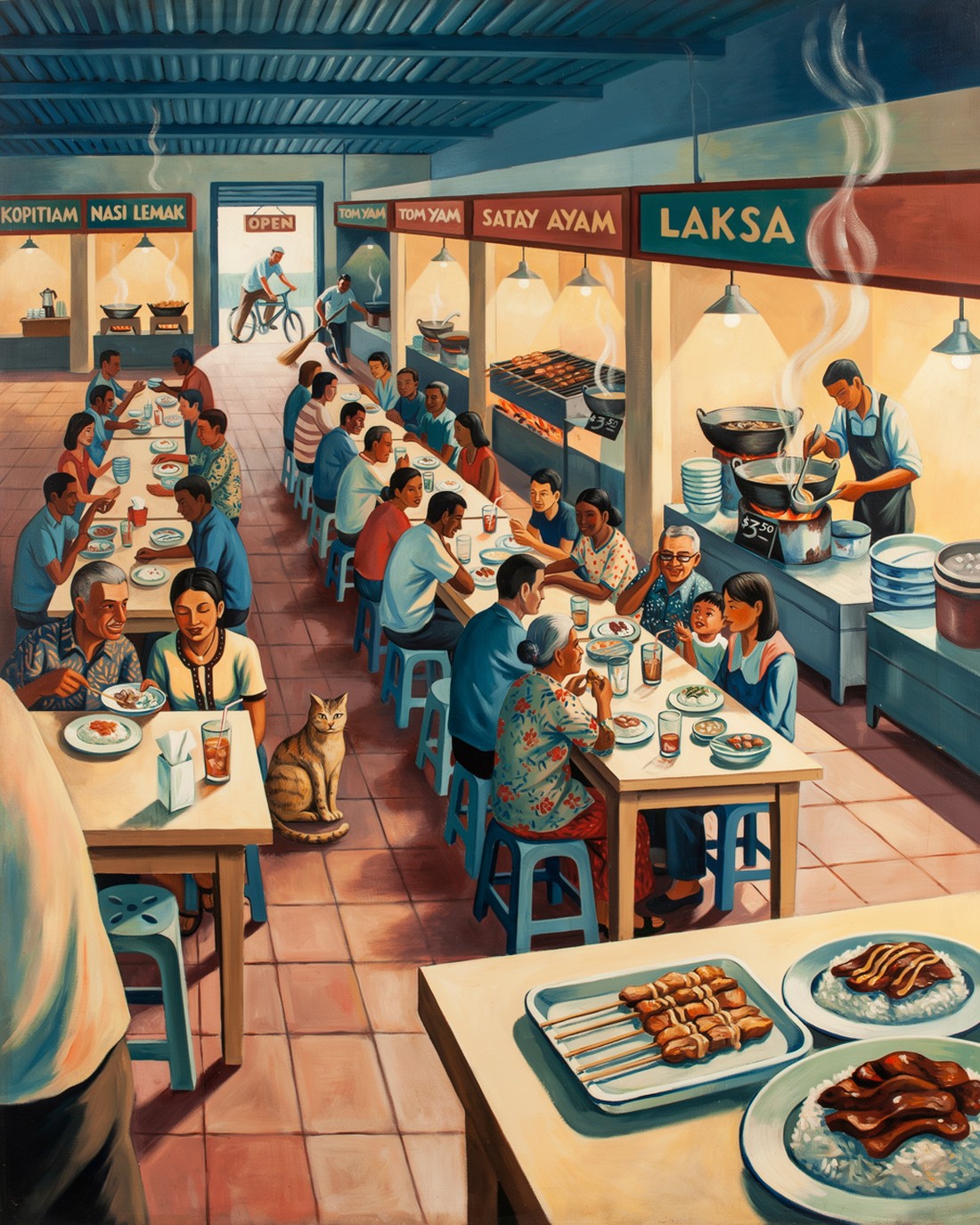
The hawker centre is the heart
Singapore does much of its eating at hawker centres, open-air halls of tiny stalls serving chicken rice, laksa, satay and more for a few dollars, side by side. The tradition is loved so much that Singapore's hawker culture was added to UNESCO's list of intangible cultural heritage in 2020. Queue at the stall, carry your own tray, and eat like a local.
Good to know: Singapore's hawker culture is UNESCO-listed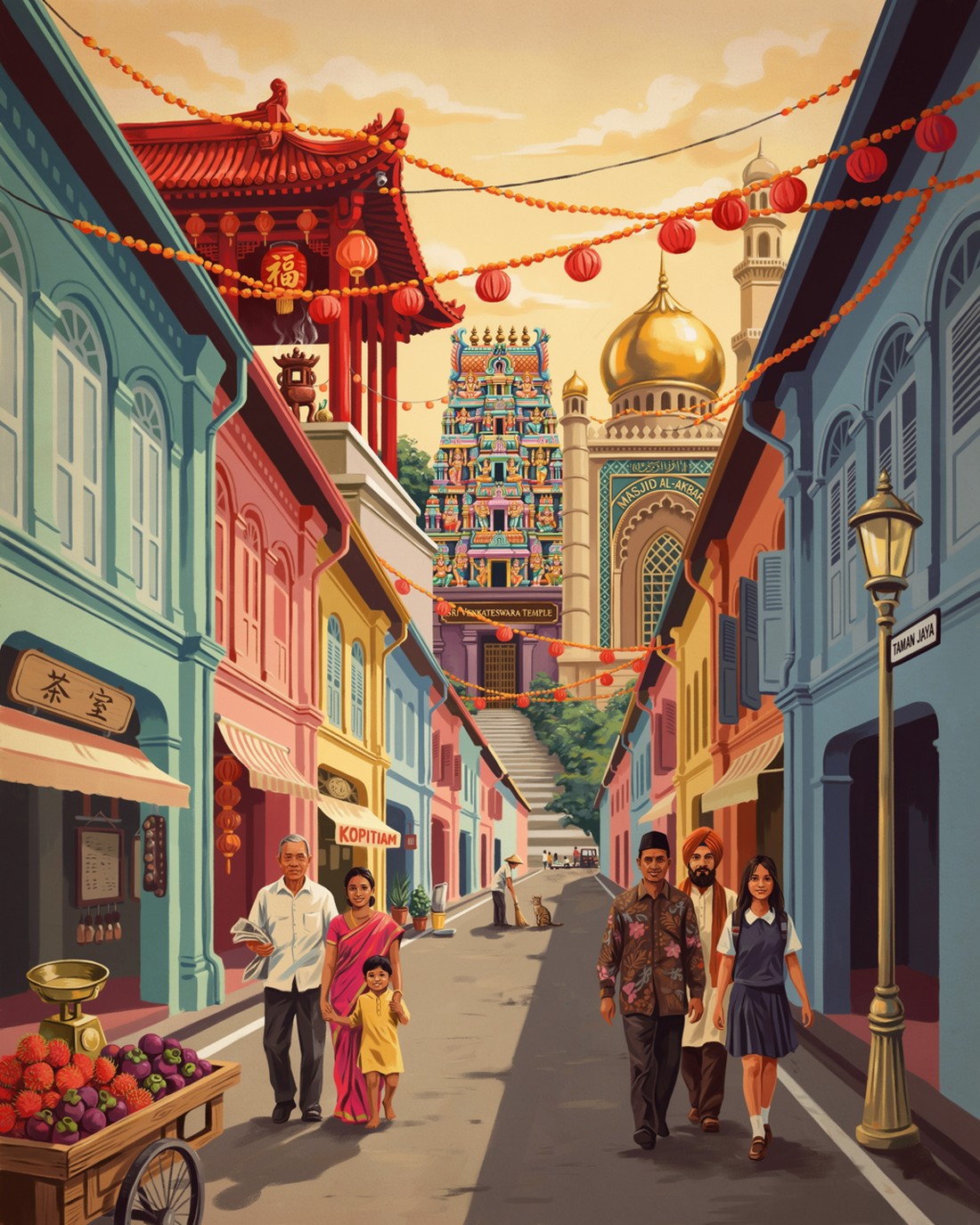
Four cultures, one island
Singapore weaves together Chinese, Malay, Indian and other communities, and it shows in the food, the festivals and the four official languages: English, Malay, Mandarin and Tamil. Wander from Chinatown to Little India to Kampong Glam and you cross whole worlds in a short walk. That easy mix is a point of real pride.
Say it: makan (MAH-kahn), the local word for eating well
A city in a garden
For all its towers, Singapore calls itself a city in a garden, and means it: greenery spills down buildings, and the giant Supertrees at Gardens by the Bay light up over the water each night. It is a small island that decided to stay green on purpose, and locals take quiet pride in how clean and planted it feels.
Good to know: the Supertrees put on a free light show most eveningsSingapore packs many cultures and faiths onto one small island and keeps it clean, green and orderly, something residents take real pride in. A little courtesy goes far: keep to the left on an escalator, no eating or drinking on the trains, and a friendly word in any of its languages is always welcome.
No links here, nothing to buy. This part is just to help you travel well.
Sources, and how this guide was checked
Last reviewedJul 2026, 8 of 9 dated items inside their review window
What the last check foundFirst publication. Confirmed the 9% GST that is built into prices and that Budget 2026 held the rate with no rise announced, the tourist GST refund with its S$100 minimum for goods bought to take home, and that there is no nightly tourist or bed tax. Also confirmed the free, mandatory SG Arrival Card filed within three days before arrival, that US visitors enter without a visa for up to 90 days, and the local emergency numbers.
- Inland Revenue Authority of Singapore (IRAS)the current GST rate of 9% that is already included in displayed prices
- Singapore Customsthe Tourist Refund Scheme, the S$100 minimum spend, goods only, and the eTRS kiosks at Changi and Seletar
- Immigration and Checkpoints Authority (ICA)the free, mandatory SG Arrival Card filed within three days before you arrive
Our own judgmentThe daily cash share, the tipping feel, and how often a hawker stall or wet-market vendor turns out to be cash only are our own estimate from experience and from consistent traveler reports, not an official figure. Card acceptance is very wide but not total, so treat our read as a guide, not a guarantee.
How we checkHow every guide is researched, checked and dated
More money guides in Asia
If you are also weighing up nearby destinations, each guide covers cards, cash, ATMs and the fees to expect.





Going deeper on Singapore
The money questions people ask on the ground.
Short, focused answers to the specific things that catch first-timers out in Singapore.
- Taxis in Singapore, and the Grab appSingapore taxis are metered, honest and strictly regulated, and Grab makes booking effortless. The only thing to understand is the list of legitimate surcharges, not scams. Here is how it works.
- Tipping in SingaporeSingapore is not a tipping country. Most restaurants add a 10% service charge, shown as the ++, so a tip is already built in. At hawker centres and for taxis, no tip is expected. Here is what you actually owe.
- Do I need cash in Singapore, or can I use cards?Short answer: a card for almost everything, a little cash for hawker stalls. Singapore is very card-friendly, and even many hawker centres now take cashless. Here is how to handle it.
- Bringing your dog or cat to Singapore.Singapore is unusual among rabies-free destinations. Unlike Australia, New Zealand, or Japan, the US now sits in Singapore's middle tier, which means no quarantine by default. The process is more about paperwork choreography than a long wait: licences filed on time, a rabies titer with strict timing, and, since April 2026, an approved pet agent to clear your pet on arrival. Two specific situations still trigger a 10-day home quarantine, so the whole game is avoiding those. Here is the route.
- Staying connected in Singapore.Singapore is small, almost entirely covered and full of free wifi. That combination produces an answer we do not often get to give: on a short stop you may not need to buy anything at all.
- What does getting sick in Singapore cost a visitor?Singapore has some of the best hospitals in Asia and one of the clearest positions on who pays for them. Citizens are heavily subsidised. Visitors are not subsidised at all, and the difference is the entire story.
This is how Singapore stands today.
Money rules move. We can let you know for free if that changes.