True Trip Costs: Saudi Arabia
before you go
- DoSay riyals when a screen offers dollars
- CarryCards work almost everywhere, metro gates included
- Don'tThe unlicensed street taxi is not worth the saving
- ExpectBudget for the highest VAT in the Gulf
- ExpectVisa: Required, and it costs
- ExpectMunicipality levy: 5%, or 2.5% lower down
That's the short version. Below: every fee we checked, what it all adds up to, and the traps we help you dodge.
No match. See all guides.
Money in Saudi Arabia, sorted.
A calm, current plan for the money side of your trip: how the riyal works, why the 15% VAT matters more than anything else, how to claim it back, and the metro ticket that costs a dollar.
What you can refuse to pay here
The room rate isn't the bill, and the sticker rate isn't the price. In Saudi Arabia, dynamic currency conversion alone can quietly cost a typical traveler about $80 to $213, and it's one of several fees you can refuse.
Money scorecard
Saudi Arabia
- Ease of payingEasy
- Cash dependenceLight cash use
- Daily costPricier
- Getting aroundSome caution
- CurrencyStable
Every rating is our own judgment from the Saudi Arabia guide, not a score.
See the full Saudi Arabia guideThe US State Department currently rates Saudi Arabia Level 3, Reconsider Travel. The advisory cites the hostilities between the United States and Iran that began on February 28, 2026, an ongoing threat of drone and missile attacks, and significant disruption to commercial flights. That is the US government's assessment, published on the page linked below, and what to do with it is your call.
This link goes to the State Department's advisory index rather than a country page, because we could not verify a stable Saudi-specific URL at this check. Select Saudi Arabia from the list for the current wording.
It changes the money side whether or not it changes your plans. Travel insurance bought after an advisory is already public will generally not pay out for cancelling because of that advisory, so the cover that actually helps here is a refundable rate, the airline's own rebooking policy, or a cancel for any reason upgrade if your policy sells one. Gulf airports are open but have closed at short notice, and US carriers have suspended some nonstop routes into the region. Confirm your flight is still operating before you pay for anything non-refundable, and keep the booking flexible if you can.
The three things people ask
Will my card work? Do I need cash? Are ATMs easy?
The quick read for a first trip.
Your card
Works almost everywhere
Visa and Mastercard across hotels, malls, restaurants, supermarkets, fuel, metro gates and taxis, with Apple Pay and Google Pay widely supported. Amex is thinner, so do not rely on it alone.
Check yours →Cash
A small float only
SAR 200 to 400 in small notes covers souks, small vendors and tips for a week. A riyal is only about 27 cents, so tips here run to ten riyals rather than one.
How much to carry →ATMs
Abundant
Airports, malls and bank branches throughout the cities, and foreign cards work normally. Withdraw a sensible amount in one go, and decline the offer to be billed in dollars.
See ATMs in Saudi Arabia →(opens in a new tab)Cash or card
The most cashless of the Gulf states, by some margin.
A rough feel for everyday spending rather than a measured figure. Card and phone payment acceptance is deep here, covering metro gates, taxis, restaurants, malls and fuel, and ride-hailing is card in-app by default. What is left is souks, small independent vendors and tipping. A few hundred riyals covers a week of that.
See what the trip really costs →Your money plan
Four steps and you're set.
Before you go
- Apply for the eVisa on the official Visit Saudi portal only. It is a year, multiple entry, and the fee includes mandatory medical insurance.
- Check your passport has six months left from your arrival date.
- Download Uber and Careem, plus Darb if you are going to Riyadh, because the metro is the cheapest thing in the country.
Landing
- In Riyadh, the metro Yellow Line runs from the terminals into the city for about SAR 4. An app is roughly SAR 60 to 120.
- Use official taxi ranks or the apps. Unlicensed street taxis are illegal and carry real risk.
- Save the right emergency number: 911 in Riyadh, Makkah, Madinah and the Eastern Province, 997 for an ambulance elsewhere.
Day to day
- Tap for almost everything. Keep a few hundred riyals for souks and tips.
- Everything carries 15% VAT. Budget with that in it rather than as a surprise at the till.
- If you plan to shop, ask for the VAT refund form at the till, above SAR 500 at a participating store.
Checking out and leaving
- Ask whether the hotel rate was all-in. Expect 15% VAT and often a service charge or municipality fee on top.
- Leave time at the airport to claim your VAT refund. Goods must be unused and exported within 90 days.
- Pay in riyals, not dollars. The peg means dollar pricing only adds a markup.
Staying connected
Will my phone work here? And what will it cost?
Yes, and it is very good. stc, Mobily and Zain all give strong coverage, 5G is extensive across Riyadh, Jeddah and the main cities, and tourist SIMs are sold at the airports and in operator stores everywhere. Coverage thins in the deep desert and on the long empty highways, which matters here because the distances are genuinely long. Before you buy anything: check whether your US plan already covers Saudi Arabia, because several do, and airport wifi is good enough to sort a SIM after you land rather than at the first counter you see. The cost is where people get caught out, and on most US plans it lands in one of two buckets.
Your plan may already include it
Often, do nothing
Some US plans include slow data abroad at no extra cost. If that is you, the honest move is to leave it alone.
we earn nothing
Or it charges quietly, after the fact
The bill lands later
On pay-per-use plans the cost runs in the background while you travel, and the charge can show up weeks after you are home. Forgetting to switch off data roaming is the classic one. For a week or more, an eSIM is usually cheaper and keeps you in control.
Check what your own carrier charges before the trip, not after.
If an eSIM is the cheaper call, Nomad covers Saudi Arabia.
Get your Nomad eSIM→(opens in a new tab)we may earn a commissionMedical cover
The one cost with no price tag.
Every other number on this page has a price you can look up. This one does not, and it can be the largest of them all. Most US health plans cover little or nothing once you leave the country, and Medicare covers essentially none of it abroad. A serious illness or injury is paid up front, and a medical evacuation runs from tens of thousands of dollars to past $100,000 if you are remote or an ocean from home.
First, you may not need to buy anything.
A cheap, refundable trip close to home does not need this. And if you are healthy, headed somewhere with good care, and one of the premium cards on the shortlist above already includes emergency medical and evacuation, you may be covered already. Check your card's benefits guide before you buy. Saying that costs us the commission, and it is still the right call.
How much cover matters here
Care in the main cities is good, but costs add up and reaching top care from a remote spot takes time, so it is worth a real look for a trip here.
If you do want cover, this is what it is for: the evacuation and the up-front hospital bill, the part no card limit is meant to absorb.
Enough for most trips
Faye, or a comparable whole-trip policy
Bundles trip protection with emergency medical, which is enough cover for most travelers on a typical trip.
The deeper end
A dedicated travel-medical plan built for serious care and evacuation abroad
Stronger on medical care and evacuation, for a remote or higher-risk trip where that is the real exposure.
If it happens
Call it first, then call your insurer's 24/7 assistance line, which is what confirms payment and arranges an evacuation. Saudi Arabia is the one Gulf state where the number depends on where you are standing. 911 is the unified line in Riyadh, Makkah, Madinah and the Eastern Province, routing police, ambulance and civil defence through one centre. Outside those regions use the direct lines: 997 ambulance, 998 fire and civil defence, 999 police. Emergency stabilisation is broadly provided regardless of ability to pay, but continuing care is not free for visitors, which is partly why medical insurance is bundled into the tourist visa.
TrueTripCosts explains the gap and points to options. It does not set your coverage amounts or act as your insurance advisor, and every policy carries its own exclusions, so read them before you buy. Emergency number checked Aug 2026. Confirm the current number before you travel, as local lines can change.
Currency basics
The riyal, in plain terms.
Quick conversion
The riyal is fixed at 3.75 riyals to the dollar and has been since June 1986. Divide riyal prices by roughly 3.75 for dollars: SAR 100 is about 27 dollars, SAR 500 about 133. One riyal is about 27 cents.
The most cashless of the Gulf
Cards and phone payments cover hotels, malls, restaurants, supermarkets, fuel, metro gates and taxis. Ride-hailing is card in-app. A float of SAR 200 to 400 covers souks, small vendors and tips for a week.
15% on almost everything
The highest VAT rate in the Gulf: three times the UAE and Oman at 5%, above Bahrain at 10%, and Qatar has none at all. Introduced at 5% in 2018 and tripled in July 2020. Budget with it included rather than treating it as a surprise.
And you can claim it back
Saudi Arabia is the only Gulf state besides the UAE running a working tourist VAT refund. Live since April 2025 at more than 1,400 approved outlets, on purchases above SAR 500 at a single store, for goods exported within 90 days.
Real exchange rate
What your money is really worth here.
This is the mid-market rate, the one the banks trade at and the yardstick every other rate is measured against. Your card lands a little below it, and if a screen ever offers to bill you in dollars, that is worse again. So this is the number to expect, and how you spot a bad one.
1 US dollar is about 3.75 SAR
Taxes and refunds
The Gulf's highest VAT, and its most useful refund.
Saudi VAT is 15%, introduced at 5% in 2018 and tripled in July 2020. That is the highest in the Gulf, against 5% in the UAE and Oman, 10% in Bahrain and nothing at all in Qatar. But it is reclaimable, and the scheme actually works. ZATCA launched a tourist VAT refund on 18 April 2025, and it now runs at more than 1,400 approved retail outlets. The rules, in order: you must be a non-resident aged 18 or over; you must spend more than SAR 500, about 133 dollars, at a single participating retailer, and you cannot combine receipts from different stores, though up to three receipts from the same store on the same day can be added together; the goods must be for personal use, unused, and exported within 90 days; and you must ask for the refund form at the till, presenting your passport, then claim at the airport before you leave. Look for Tax Free or VAT Refund Available signage, because not every store participates. Worth planning for if you are shopping seriously, because 15% back on a significant purchase is real money, and it is the best refund proposition in the region.
That covers what a government adds. What you can still change is what the room itself costs, and that comes down to the booking moment: see how to pay less on hotels.
Fees and taxes to double-check
The numbers most likely to change.
These are the fees and taxes that move on political timelines, so we track each one on its own. Every line shows the amount, whether it is in effect yet, the date we last checked it, and a primary source where a clean one exists.
Saudi tourist eVisa (US citizens)
Required and not free. A one-year, multiple-entry tourist eVisa from the official Visit Saudi portal, with mandatory medical insurance bundled into the fee, and a visa on arrival also available to US passport holders. We publish no amount because sources quote different figures for the two routes and the portal is the only current one
Before you book: passports, the six-month rule and whether you need a visa. Not a US citizen, or connecting through Europe? The rules can differ, and even a layover can need its own visa. See our passports and visas guide →
Watch out for
The small traps that catch first-timers.
Tipping
Appreciated, not expected, and in cash.
Tipping in Saudi Arabia is a courtesy rather than an obligation, and it is not the US convention. Read the bill first, because a Saudi bill can carry two additions that are easy to confuse: the 15% VAT is a government tax, while a service charge, where a property adds one, is the establishment's own and is the part that covers service. Where a service charge appears, you are done. Where there is none, rounding up or leaving around 10% in a sit-down restaurant is generous. Taxi drivers do not expect a tip and a few riyals rounds up a fare. One thing worth calibrating if you are touring the Gulf: a riyal is only about 27 cents, far less than an Omani rial or a Bahraini dinar, so the normal gesture here is ten riyals rather than one note. Tip in cash, because on a bill that may already carry a service charge, cash is the part that clearly reaches a person.
Common questions
Quick answers.
How much is VAT in Saudi Arabia?
15%, the highest in the Gulf. That is three times the UAE and Oman at 5%, above Bahrain at 10%, and Qatar has none at all. It was introduced at 5% in 2018 and tripled in July 2020.
Can tourists claim VAT back in Saudi Arabia?
Yes. ZATCA launched a tourist refund scheme in April 2025, now at more than 1,400 approved outlets. You need to spend over SAR 500 at a single participating store, ask for the refund form at the till with your passport, and export the unused goods within 90 days.
Do I need cash in Saudi Arabia?
Very little. Cards and phone payments cover hotels, malls, restaurants, metro gates and taxis. Keep SAR 200 to 400 in small notes for souks, small vendors and tips.
What is the Saudi riyal pegged at?
SAR 3.75 to one US dollar, fixed since June 1986, making it one of the longest-standing pegs in the world. One riyal is about 27 cents, so divide riyal prices by roughly 3.75.
Do US citizens need a visa for Saudi Arabia?
Yes. The tourist eVisa is applied for online at the official Visit Saudi portal, often approved within minutes, and is valid one year with multiple entries. The fee includes mandatory medical insurance, and your passport needs six months validity.
How much is the Riyadh Metro?
About SAR 4 for a two-hour economy ticket, roughly a dollar, with a seven day pass around SAR 40. The Yellow Line runs to King Khalid International Airport, against roughly SAR 60 to 120 by ride-hailing app.
Do Uber and Careem work in Saudi Arabia?
Both do, licensed by the Transport General Authority so drivers are background-checked. Careem is the dominant platform locally. Avoid unlicensed street taxis, which are illegal and leave you without recourse.
What is the emergency number in Saudi Arabia?
911 in Riyadh, Makkah, Madinah and the Eastern Province, which routes police, ambulance and civil defence through one centre. Outside those regions use the direct lines: 997 ambulance, 998 fire, 999 police.
What will your trip really cost?
Name where you are going. We will show you what nobody quotes.
For instance, right now
 ColombiaHotels charge 19% IVA, but as a foreign tourist you are exempt, and about half try to add it anyway.
 JapanThe world's most high-tech country is still cash-first, and most bank ATMs refuse US cards.
 CzechiaCzech law gives you three hours to cancel a bad currency exchange and get your money back, on amounts up to 1,000 EUR.
 GreeceGreece's climate fee charges an Airbnb-style rental about 8 EUR a night against 2 for a budget hotel.
 El SalvadorThe country that made Bitcoin legal tender?
 CambodiaThe US dollar is Cambodia's everyday currency, and ATMs hand you crisp $100 bills nobody can break.
 TurkeyUS citizens need no visa and no e-visa for Turkey, scrapped in 2023.
 ItalyMost Italian restaurants add a coperto, a per-person cover charge of commonly 2 to 3 euros, before you have ordered anything.
The one thing most people get wrong about Saudi Arabia
Guide checked Aug 2026You expect to sort out a tax refund at the airport on your way home, as you would in Europe.
Saudi Arabia charges 15% VAT, three times the UAE and Oman, and it is one of only two Gulf states where a visitor can claim it back. The claim starts at the till, not at departures, so leaving it until the airport means losing it.
What to doAsk the retailer for the refund form with your passport at the moment you buy. No form, no refund, however large the receipt.
Everything we checked
What Saudi Arabia actually charges you, in one place.
5 things we verified for Saudi Arabia, grouped by the kind of thing they are. The numbers are below; this is the shape of them.
fees nobody quotes
traps to dodge
timing
The number
What you'll really spend in Saudi Arabia.
Your flights if you want them counted, your room, your on-the-ground spending, the two fees most US cards add without telling you, and Saudi Arabia's tourist tax. One number, nothing waiting on the statement. No bank to pick, no sign-up, nothing saved.
Optional. Enter your round trip fare per traveler to fold flights into the total.
Total trip realistically somewhere between $0 and $0.
Getting thereflights, and what the border costs
Watch out for
Prepare ahead
These carry no dollar figure by design: each is named because it is real, and there is nothing honest to price here.
Departure tax is not a separate line here. Where a country charges one it is collected inside your airfare, so it is already in the flight figure, and adding it again would count it twice.
On the ground detailyour room, your days, and how much of it is cash
Whether at an ATM or a card terminal in a shop or restaurant, always choose to be charged in the local currency, not dollars. Paying in dollars (called dynamic currency conversion) lets the machine set its own, worse, exchange rate on top of any fee.
Fees nobody quotes youthe part that lands on the statement weeks later
What you'll pay
Plus the one-off entry charge, which sits in Getting there above with the flights, because it is per person rather than per night.
What you can refuse, and what the lookalike sites charge, is set out under Costs nobody tells you about below, with the two figures kept apart from these ones.
Costs nobody tells you about
Most of it you can keep. Here is every dollar of it.
Every one of them, and how to avoid it5 items
Two of these are money you hand over by default; the rest is money you keep by knowing. Each is its own line.
What you'll pay unless you act
- Your own bank's foreign feeswhat the fees above come toMost US cards add a percentage on what you buy and on the cash you pull, plus a few dollars per ATM withdrawal. Nothing about that is a cost of the trip; it is a cost of the card you happened to bring.A no-foreign-fee card takes both fee lines above to zero.The cards that do not charge it
- Paying in dollars at the terminalabout 3 to 8%on what you cardDynamic currency conversion lets the machine set its own rate on top of any fee, and it runs about 3 to 8 percent on whatever you put on the card. It is the single easiest charge on this page to refuse, and it costs nothing to say no.Choose SAR every time, at a till and at an ATM.How to decline it
- The airport or hotel exchange deskExchange counters make their money on the spread rather than on a stated fee, which is why we publish no percentage for it: it moves by counter, by hour and by note. The rule is what is reliable, not the number.Withdraw from a bank ATM instead, and never change cash at the airport.Getting cash here
What we'll help you dodge
- The sales tax you can claim backSaudi Arabia refunds sales tax to visitors on qualifying shopping, with the rate and any minimum spend set out in this guide. Most travelers never claim it, and we put no dollar figure on it, because it depends on what you buy.Ask for the tax-free form at the till, keep the goods unused, and claim on the way out.The rate and the minimum spend
- The unlicensed street taxiUnlicensed street taxis are illegal, and there is no recourse if something goes wrong with one.Use official ranks or the Uber and Careem apps rather than an unlicensed street taxi.How taxis work here
Where these numbers come fromevery assumption, and its limitssources
These are the assumptions behind the number. Change the room price, nights, travelers, or travel style above, and every line here moves with them.
- Hotel
- Daily spending
- Flights
- Cash vs card
- ATM withdrawals
- Foreign fee
- The range
- Tourist tax
Rough guide, not a quote. The percentage here is a blended stand-in for a typical US card's foreign fee, not your exact rate. The real number moves with the card you carry: one no-foreign-fee card can cover both sides, while a plain rewards credit card only removes the fee on what you buy, and cash still costs a little unless that card also waives ATM and foreign-cash fees. A debit card, or accepting the "pay in dollars" (dynamic currency conversion) offer at a till or ATM, can push it higher. Rates checked Jun 2026 and rounded.
How we check and date every figureSaudi Arabia, TTC-ed
truetripcosts.comWhat this assumes
Tips are already inside the daily spending figure, never added on top.
Not sure which card to bring? See my pick for Saudi Arabia.
Already carry a card with no foreign transaction fee? Then you are set for Saudi Arabia, and can skip this. There is nothing to buy.
If you are getting a card for Saudi Arabia, this is the pairing I would pick: a no-foreign-fee credit card for spending, and a fee-free ATM debit card for cash. We earn nothing on these today. Always confirm the current fee with the issuer before you apply. Checked Jun 2026.
Capital One charges no foreign transaction fee on any of its cards.
No foreign transaction fee
Fee-free ATM cash worldwide

Want one account that holds and spends in the local currency? A different job from the three above, and the one I reach for abroad. It is free to open; you can create a virtual card in the app and add it to your phone wallet in minutes, without waiting for the physical card; and you can convert US dollars into the local currency inside the account before you travel, then spend from that balance. Wise uses the mid-market rate plus a small conversion fee (around 0.4% and up), with no flat foreign fee.
The three picks above pay us nothing, and their tags say so. Wise is the only option here that can earn us a commission, and its tag says that too. Paid or not, the pick is still the pick.
Before you fly
At least 14 countries now make you file a form online before you fly. 13 of them are free. One really does charge, and it is not the one you would guess.
Saudi Arabia does not ask for one, so this is not a job for this trip. It is worth knowing anyway, because the list keeps growing and the pattern is always the same: the filing is new, obscure and mandatory, and the paid lookalikes outrank the government site because the real ones do not buy ads.
See every form we can source, with the official address for eachWhen to go
Cheaper and busier months in Saudi Arabia.
The month you pick moves the budget as much as the country does. Here is the shape of Saudi Arabia's year, with no price attached to it, because an honest one does not exist.
- Busy and pricey
- In between
- Cheaper and quieter
- Cheaper and quieter
- May to Sep, outside Hajj
- What drives the peak
- Cool, dry winter weather, the AlUla season and the events calendar, and the Riyadh Season running through the cooler months
Travelers, not touristsA few words of Arabic go a long way
A few words of Arabic go a long way
Arabic is the language and English is common in the cities and in anything tourism-facing. Saudi Arabia has opened to visitors very recently, and curiosity about where you are from is usually genuine rather than transactional.
Say a few words
Tip: Hospitality runs on qahwa, pale green-gold coffee spiced with cardamom and sometimes saffron, poured short into small handleless cups, with dates alongside. Accepting at least one cup is the polite move, and the host will keep pouring until you tilt the cup gently side to side. Note there is no alcohol anywhere in the country, which does quietly simplify a restaurant bill.
Know a story
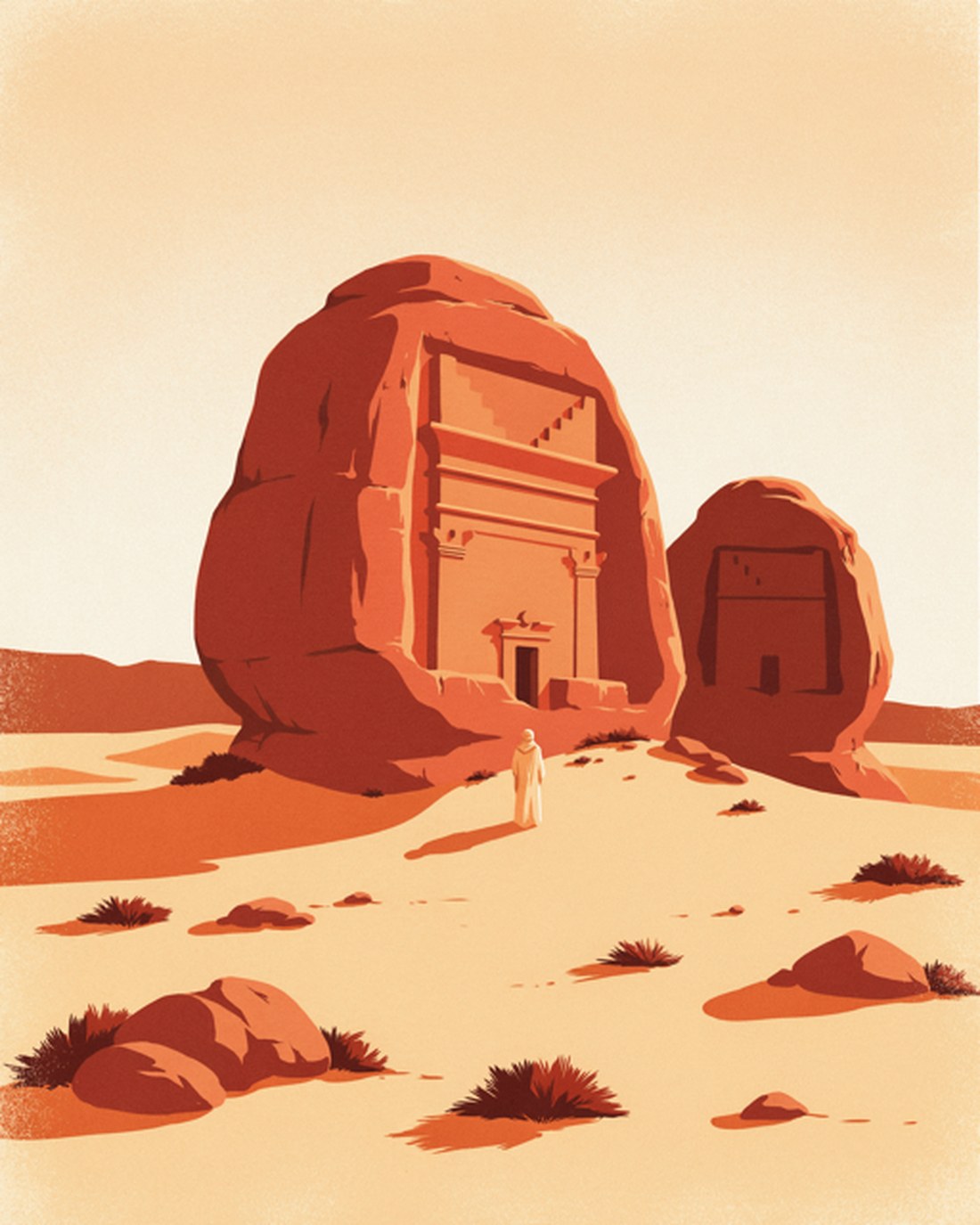
Tombs cut into standing rock
At Hegra, in AlUla, the Nabataeans carved more than a hundred monumental tombs directly into isolated sandstone outcrops rising out of the desert, complete with stepped crowns, columns and inscriptions naming the families who commissioned them. It was the southern city of the same civilisation that built Petra, and it sat on the incense road running north from Dhofar. It became Saudi Arabia's first UNESCO World Heritage site.
Good to know: the same people built Petra, and this was their second city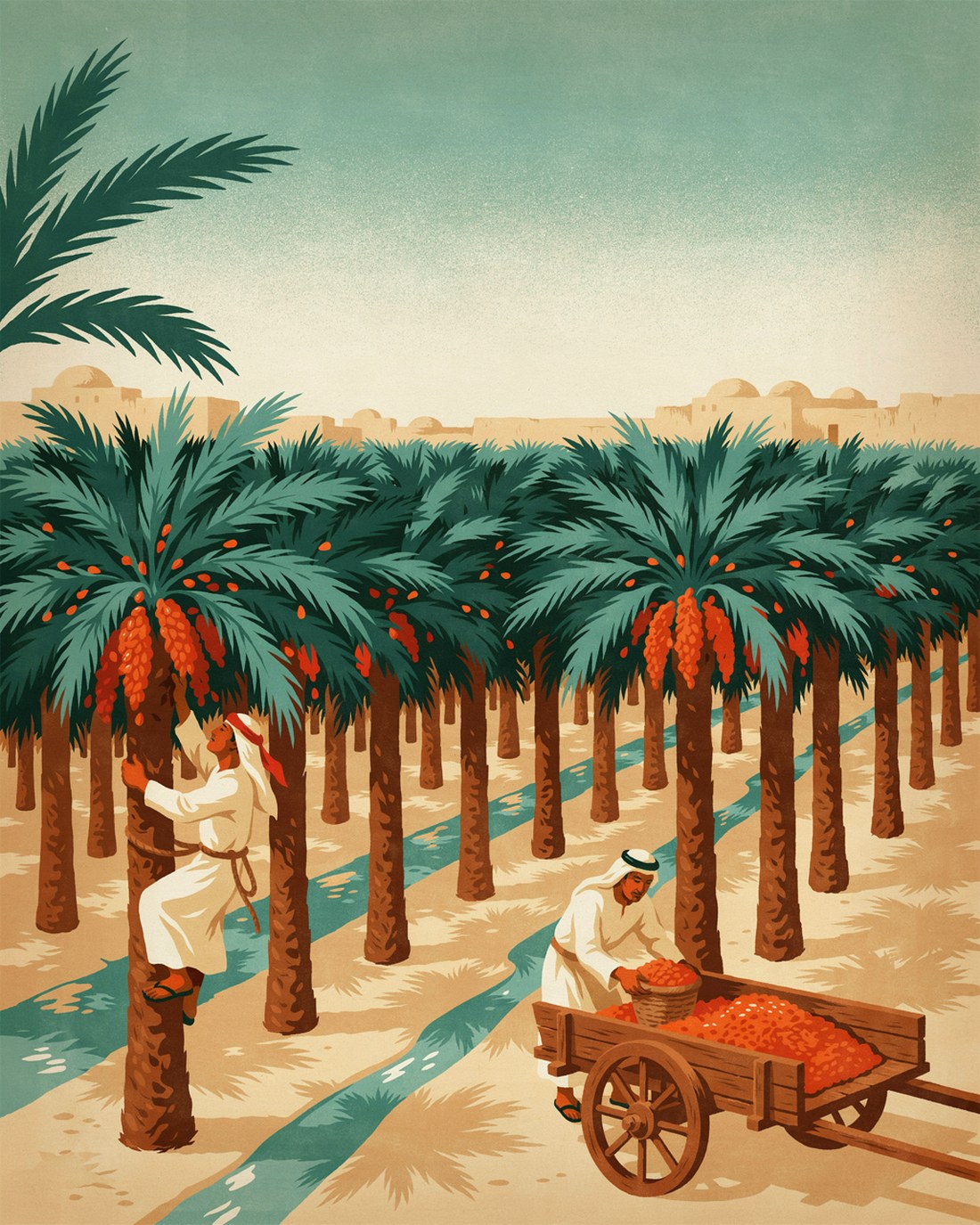
Millions of palms, fed from below
Al-Ahsa in the Eastern Province is the largest oasis in the world, a green sprawl of some two and a half million date palms watered by natural springs rising through the desert floor. It has been continuously cultivated for thousands of years, and the irrigation channels threading between the trunks are the reason a city of that size exists in that place at all. UNESCO lists it as a cultural landscape.
Say it: al-AH-sa, and the dates are the local export, not oil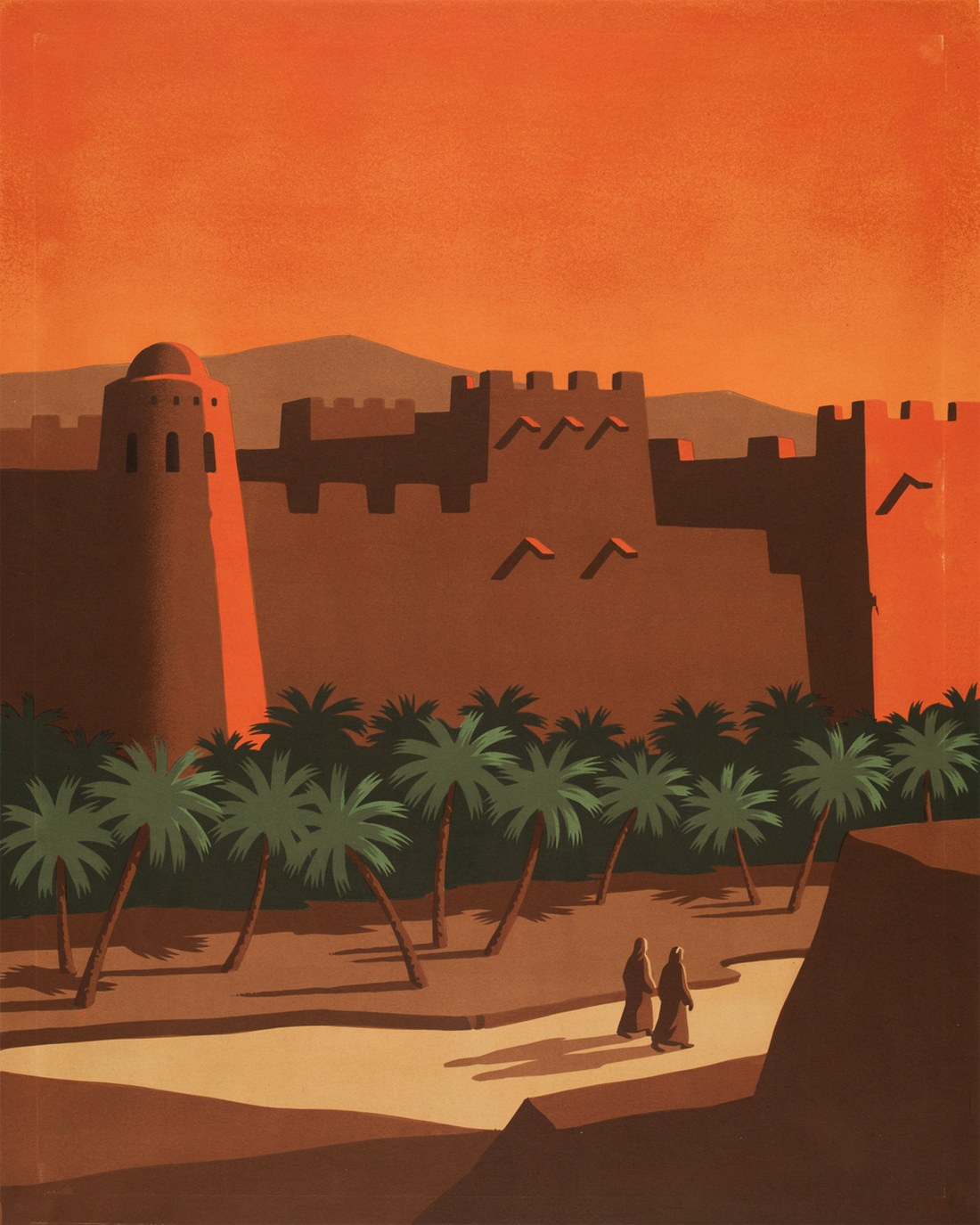
Where the country began
At-Turaif, in Diriyah on the edge of Riyadh, is the mud-brick district where the first Saudi state was founded in the eighteenth century. Built in the Najdi style, all tiered earthen walls, triangular vent openings and stepped crenellations, it glows a deep orange at sunset in a way that photographs badly and looks extraordinary in person. It is UNESCO listed and now the centre of an enormous restoration.
Good to know: it is 20 minutes from central Riyadh, and best at duskNo links here, nothing to buy. This part is just to help you travel well.
Sources, and how this guide was checked
Last reviewedAug 2026, 10 of 10 dated items inside their review window
Not yet individually datedWe date this guide and the fees most likely to move, but the 3 per-place tourist tax rates on this page do not carry a check date yet. They are reviewed with the guide rather than on their own schedule, and putting each of them on one is work in progress.
What the last check foundFirst published August 2026. Verified at this check: the riyal's peg at 3.75 to the dollar, unchanged since June 1986, against SAMA, whose Governor restated the commitment at the AlUla Conference in 2026; the 15% VAT rate against ZATCA and multiple tax practices; the tourist VAT refund scheme, live since 18 April 2025 at more than 1,400 approved outlets with an SAR 500 minimum at a single retailer and a 90 day export window, against ZATCA reporting and Gulf News; the one-year multiple-entry tourist eVisa with mandatory medical insurance bundled, against the official Visit Saudi portal; the emergency number structure, 911 unified in Riyadh, Makkah, Madinah and the Eastern Province with 997, 998 and 999 as direct lines, against the CST National Numbering Plan and my.gov.sa; and the Riyadh Metro's opening, scale and roughly SAR 4 two-hour fare. Also recorded: the US State Department has Saudi Arabia at Level 3, Reconsider Travel, following the February 2026 hostilities between the United States and Iran.
- SAMAcommitment to the 3.75 riyal peg
- ZATCAthe 15% VAT and the tourist refund scheme
- Visit Saudithe official tourist eVisa portal
- Saudi national platformemergency contact numbers and government services
- US Department of Statecurrent travel advisories, select Saudi Arabia
Our own judgmentThe peg, the VAT rate, the refund scheme's existence and terms, the visa structure and the emergency numbers are all well sourced and linked above. Four things are deliberately hedged. No visa fee is printed, because current sources quote different amounts for the online and on-arrival routes while the portal carries the live one. The 90 day allowance is genuinely ambiguous, with the portal's own wording supporting either 90 days per visit or 90 days in total and reputable guides split, so we flag it rather than choose. On the refund minimum, four credible sources including Gulf News say SAR 500 and one outlier says SAR 5,000, and we have gone with 500. And hotel service charges and municipality fees we could not pin to a standard rate, so the tax model uses the certain 15% as a floor and tells the reader to ask. Airport taxi fares vary from SAR 50 to 180 across current sources and are given as a range. Metro fares are consistently reported but from travel sources rather than an operator tariff we could open. The cash share, float and tipping norms are our own read.
How we checkHow every guide is researched, checked and dated
More money guides in the Middle East
If you are also weighing up nearby destinations, each guide covers cards, cash, ATMs and the fees to expect.

Going deeper on Saudi Arabia
The money questions people ask on the ground.
Short, focused answers to the specific things that catch first-timers out in Saudi Arabia.
- Do US citizens need a visa for Saudi Arabia?Yes, and it is the most expensive entry in the Gulf, but it is also the most generous: a year of validity, multiple entries, and medical insurance folded into the price.
- Cash or card in Saudi Arabia?Saudi Arabia went card-first fast. Cards and phone payments cover almost everything in the cities, the riyal does not move, and the 15% VAT is the one number worth planning around.
- Do you tip in Saudi Arabia?Not obligatory, and not the US convention. Service is often charged for already, and where it is not, a small amount in cash is welcome rather than expected.
- Taxis, apps and the metro in Saudi ArabiaSaudi cities are vast and built for cars, so getting around is mostly apps. Riyadh is the exception now, because its new metro is absurdly cheap and reaches the airport.
- The Saudi VAT refund, and the step everyone missesShort answer: Saudi Arabia charges the highest VAT in the Gulf and, unusually for the region, gives it back on shopping. The scheme works, but it starts at the till rather than at the airport, and that is where most claims are lost before they begin.
- Saudi Arabia hotel taxes and fees, explainedShort answer: about a fifth on top, and how much depends on the stars on the door. Saudi Arabia charges the highest VAT in the Gulf, and the municipality levy beside it asks cheaper hotels for half what it asks the smart ones. Here is what lands on the bill.
- Staying connected in Saudi Arabia.Saudi Arabia has two things worth knowing that are not about price: buying a local SIM involves fingerprints, and the country's much-reported 2017 decision to allow internet calling is disputed by some current sources.
- What does getting sick in Saudi Arabia cost a visitor?Saudi Arabia is the rare country that answers part of the insurance question at the border: a basic emergency policy from a Saudi-regulated insurer is bundled into the tourist visa itself. Knowing exactly what that policy is, and is not, is this page.
This is how Saudi Arabia stands today.
Money rules move. We can let you know for free if that changes.