True Trip Costs: Greece
before you go
- DoSay euros when a screen offers dollars
- CarryCities take cards, islands take notes
- WithdrawDraw your cash before the ferry, not after
- ExpectRound up, or a little more for a meal worth it
- ExpectThe real bill: The boat or flight to Athens
- ExpectAthens from ATH: 40 euros day, 55 euros night, fixed
That's the short version. Below: every fee we checked, what it all adds up to, and the traps we help you dodge.
No match. See all guides.
Money in Greece, sorted.
A calm, current plan for the money side of your trip: what to tap in the cities, how much cash to carry for the islands, and the per-night fee that surprises first-timers at checkout.

What you can refuse to pay here
The room rate isn't the bill, and the sticker rate isn't the price. In Greece, dynamic currency conversion alone can quietly cost a typical traveler about $52 to $139, and it's one of several fees you can refuse.
Money scorecard
Greece
- Ease of payingMixed
- Cash dependenceCarry some cash
- Daily costModerate
- Getting aroundSome caution
- CurrencyStable
Every rating is our own judgment from the Greece guide, not a score.
See the full Greece guideGreek bank ATMs dropped their withdrawal fees. Since August 2025, cash withdrawals at ATMs run by Greek banks, Alpha Bank, National Bank of Greece, Eurobank and Piraeus Bank, carry no local commission for any cardholder, tourists included. Independent, non-bank machines are now legally capped at a modest fee per withdrawal, well down from the 2 to 4 euros they used to charge. Your own bank's foreign transaction fee or ATM fee can still apply, so a no-fee card still matters, but the Greek side of the cost has gotten meaningfully cheaper.
Since April 2026 the EU's Entry/Exit System (EES) has been live at Schengen borders. Instead of a passport stamp you give a quick fingerprint and photo on arrival, and the system then tracks your 90 days automatically. There is no fee, no form and nothing to apply for.
The catch is time, not money: several major airports have run peak queues of two to five hours through the summer, and some countries are using EU-permitted pauses to ease them. Build in a buffer on arrival, especially on a tight connection.
ETIAS, the separate online authorization, is not running and has no launch date. The EU removed its late-2026 target in July 2026 and says it will announce a real date several months ahead, so any site selling you an ETIAS today is selling something that does not exist yet. For now a US passport is all you need.
Full detail, and the official EU pages, on passports and visas.
The three things people ask
Will my card work? Do I need cash? Are ATMs easy?
The quick read for a first trip.
Your card
Works well in the cities
Visa and Mastercard are widely accepted in Athens, Thessaloniki and the bigger resort towns, and businesses are legally required to have a working terminal. On smaller islands and at traditional tavernas, a card machine that is conveniently "broken" still happens.
Check yours →Cash
Keep more than you think
Beach bars, kiosks (periptera), local ferries, taxis and small island shops still run on cash, and the per-night Climate Resilience Fee is usually settled in cash at checkout. Carry more here than you would in Italy or France.
How much to bring →ATMs
Free at Greek banks, scarcer on tiny islands
Withdrawals at Greek bank ATMs (Alpha Bank, National Bank of Greece, Eurobank, Piraeus Bank) carry no local withdrawal fee. Independent machines are capped but still cost more. On small islands, pull cash before you arrive, since the one or two local ATMs can run dry in peak season.
See ATMs in Greece →(opens in a new tab)Cash or card
Greece splits in two: card-friendly cities, cash-leaning islands.
A rough feel for everyday spending. Athens and Thessaloniki run close to the rest of card-friendly southern Europe. Smaller islands, village tavernas, beach loungers, kiosks and local ferries still lean heavily on cash, and that pulls the country-wide average up.
See what the trip really costs →Your money plan
Four steps and you're set.
Before you go
- Bring a no-foreign-fee Visa or Mastercard for cities and hotels, plus a backup card from a different bank.
- Get a no-fee debit card for cash. Charles Schwab refunds ATM fees worldwide; Wise and Revolut are low-fee.
- If you are island-hopping, plan to carry more cash than usual between stops.
- Set a travel notice with your bank so a first-day tap or ATM pull does not get blocked.
At the airport
- Skip the airport exchange counters, the rates are poor.
- Pull euros from a Greek bank ATM (Alpha Bank, National Bank of Greece, Eurobank, Piraeus Bank), not a standalone tourist-zone machine, and decline "convert to USD."
- If you are heading straight to a smaller island, withdraw a larger amount now rather than hoping for an ATM there.
Day to day
- Card for hotels, bigger restaurants and shops in Athens, Thessaloniki and the main resort towns.
- Cash for tavernas, kiosks, beach loungers, local ferries and small island shops.
- Keep small notes on hand, since the Climate Resilience Fee is usually paid in cash at checkout.
- Always choose euros, never dollars, on every card terminal and ATM screen.
A golden rule
- Always pay in euros, never in dollars. Choosing your home currency (dynamic currency conversion) quietly adds 3 to 8%.
- If a taxi or taverna says the card machine is "broken," have cash ready rather than arguing the point.
Staying connected
Will my phone work here? And what will it cost?
Yes, and coverage is strong on the mainland and the main islands. Greece's three networks, Cosmote, Vodafone Greece and Wind Hellas (now branded Nova), give near-universal 4G and growing 5G across Athens, Thessaloniki and tourist islands like Santorini, Mykonos, Crete and Rhodes. Cosmote has the widest reach on smaller islands and rural mountain areas. Signal can thin out on tiny islands, remote beaches and in the mountainous interior, so download offline maps before heading somewhere isolated, and bring an eSIM rather than relying on hotel wifi alone. The cost is where people get caught out, and on most US plans it lands in one of two buckets.
Your plan may already include it
Often, do nothing
Some US plans include slow data abroad at no extra cost. If that is you, the honest move is to leave it alone.
we earn nothing
Or it charges quietly, after the fact
The bill lands later
On pay-per-use plans the cost runs in the background while you travel, and the charge can show up weeks after you are home. Forgetting to switch off data roaming is the classic one. For a week or more, an eSIM is usually cheaper and keeps you in control.
Check what your own carrier charges before the trip, not after.
If an eSIM is the cheaper call, Nomad covers Greece.
Get your Nomad eSIM→(opens in a new tab)we may earn a commissionMedical cover
The one cost with no price tag.
This is the one cost with no price tag, and it can be the largest on the page. Most US health plans and Medicare cover little or nothing abroad, so a serious illness or evacuation is paid up front. How medical costs work abroad, country by country →
First, you may not need to buy anything.
A cheap trip close to home, or a premium card that already includes emergency medical and evacuation, may mean you need nothing here. Check your card first. Saying that costs us the commission, and it is still the right call.
How much cover matters here
Care in the main cities is good, but costs add up and reaching top care from a remote spot takes time, so it is worth a real look for a trip here.
If you do want cover, this is what it is for: the evacuation and the up-front hospital bill, the part no card limit is meant to absorb.
Enough for most trips
Faye, or a comparable whole-trip policy
Bundles trip protection with emergency medical, which is enough cover for most travelers on a typical trip.
The deeper end
A dedicated travel-medical plan built for serious care and evacuation abroad
Stronger on medical care and evacuation, for a remote or higher-risk trip where that is the real exposure.
If it happens
Call it first, then call your insurer's 24/7 assistance line, which is what confirms payment and arranges an evacuation. 112 works across the mainland and the islands. Reaching a major hospital from a smaller island can take time.
TrueTripCosts explains the gap and points to options. It does not set your coverage amounts or act as your insurance advisor, and every policy carries its own exclusions, so read them before you buy. Emergency number checked Jul 2026. Confirm the current number before you travel, as local lines can change.
Renting a car
Where the rental desk makes its money.
Renting is often the best way to see Greece, and the cover is where the counter earns its margin. The rental comes with basic collision cover, but it leaves you owing the excess, the first slice of any damage or theft bill, often several hundred to a couple of thousand dollars, held on your card until the car is back. The desk will offer to erase that excess. It is a real product, just priced at the counter for far more than the same cover costs if you arrange it before you go.
You may not need to buy anything at all. Some US credit cards include rental collision cover when you pay with the card and decline the counter's version, so check what your own card covers on rentals before you add anything extra. We cannot read your policy for you, and flagging this can cost us the sale below, but it is the honest first step.
If your card does not cover it, or you would rather have cover built for this, a standalone policy bought ahead is the cheaper way to handle it. It covers the damage and theft the rental leaves you liable for, often including parts the counter cover leaves out like tires, glass and the underbody, and mechanical faults stay the rental company's problem. RentalCover covers rentals in Greece. Read what the policy includes before you buy.
Cover your rental with RentalCover→(opens in a new tab)we may earn a commissionCurrency basics
The euro, in plain terms.
Quick conversion
About 1.14 dollars to 1 euro in mid-2026, so euro prices run a touch higher than the same number in dollars. A 10 euro meal is roughly $11.40, and 100 euros is about $114.
Notes and coins
Notes run 5, 10, 20, 50, 100, 200 and 500 euros, though the 200 and 500 are rare and many small shops cannot break them. Coins run from 1 cent to 2 euros and add up fast, useful for kiosks and tips.
Carry small notes
Keep 5s, 10s and 20s on hand for tavernas, kiosks (periptera), beach loungers, taxis and local ferries between islands, several of which are cash-only.
Local instant-payment app
IRIS, Greece's bank-to-bank instant payment system, is built for Greek bank accounts, so it is not a tool for a US visitor. Stick to your card or cash.
Real exchange rate
What your money is really worth here.
This is the mid-market rate, the one the banks trade at and the yardstick every other rate is measured against. Your card lands a little below it, and if a screen ever offers to bill you in dollars, that is worse again. So this is the number to expect, and how you spot a bad one.
1 US dollar is about 0.88 EUR
Taxes and refunds
The per-night fee on your room, and money back on shopping.
Greece's standard VAT is 24%, among the highest in the EU, though it runs lower (17%, 9% or 4%) on a handful of eastern Aegean islands including Leros, Lesvos, Kos, Samos and Chios. Non-EU visitors who spend over 50 euros in one store on one day can claim a VAT refund: ask the shop for a tax-free form, keep the goods unused, and get it stamped by customs at the airport before you leave the EU. After the refund operator's fee, expect back roughly 10 to 14%, not the full 24%. This is separate from the per-night Climate Resilience Fee on your accommodation, which is not a VAT and is not refundable.
That covers what a government adds. What you can still change is what the room itself costs, and that comes down to the booking moment: see how to pay less on hotels.
Before you book: passports, the six-month rule and whether you need a visa. Not a US citizen, or connecting through Europe? The rules can differ, and even a layover can need its own visa. See our passports and visas guide →
Watch out for
The small traps that catch first-timers.
Tipping
Tip lightly, and keep it in cash.
Tipping in Greece is not mandatory but is genuinely appreciated, and it runs lighter than US norms. At a taverna or restaurant, rounding up the bill or leaving 5 to 10% is normal, a little more for a meal you really loved. For taxis, round up to the nearest euro. Hotel porters generally get 1 to 2 euros a bag, and a euro a night left for housekeeping is a kind gesture, not an obligation. Leave tips in cash when you can, since a cash tip goes straight to the person who earned it rather than into a pooled card total.
Common questions
Quick answers.
Do I need cash in Greece?
More than you might expect, especially outside Athens and Thessaloniki. Cards work well in the cities, but tavernas, kiosks, beach bars, local ferries and small island shops often run on cash, and the Climate Resilience Fee is usually paid in cash at checkout. Carry more euros here than you would in Italy or France.
What is the best ATM to use in Greece?
Use a machine run by a Greek bank, Alpha Bank, National Bank of Greece, Eurobank or Piraeus Bank, which since August 2025 charge no local withdrawal fee. Avoid standalone independent machines in tourist zones, which are capped but still cost more, and always decline the "convert to USD" option.
Should I bring US dollars to Greece?
No. Greece runs on euros, and dollars are not accepted for everyday spending. Pull euros from a Greek bank ATM after you land rather than exchanging cash at home or at an airport counter.
Do you tip in Greece?
Lightly, and it is appreciated rather than required. Round up the bill or leave 5 to 10% at a taverna, round up a taxi fare, and a euro or two for porters or housekeeping is a kind gesture. Cash tips are better than a card-terminal prompt.
How much cash should I bring for a week in Greece?
For two mid-range travelers island-hopping, very roughly 350 to 500 euros (about $400 to $570) in day-to-day cash across a week, on top of cards for hotels and bigger restaurants. Carry more if you are visiting smaller islands with limited ATMs, less if you are staying mostly in Athens.
What will your trip really cost?
Name where you are going. We will show you what nobody quotes.
For instance, right now
 ColombiaHotels charge 19% IVA, but as a foreign tourist you are exempt, and about half try to add it anyway.
 JapanThe world's most high-tech country is still cash-first, and most bank ATMs refuse US cards.
 CzechiaCzech law gives you three hours to cancel a bad currency exchange and get your money back, on amounts up to 1,000 EUR.
 El SalvadorThe country that made Bitcoin legal tender?
 CambodiaThe US dollar is Cambodia's everyday currency, and ATMs hand you crisp $100 bills nobody can break.
 TurkeyUS citizens need no visa and no e-visa for Turkey, scrapped in 2023.
 ItalyMost Italian restaurants add a coperto, a per-person cover charge of commonly 2 to 3 euros, before you have ordered anything.
The one thing most people get wrong about Greece
Guide checked Jul 2026You booked the apartment because it was cheaper than the hotel.
Greece's climate fee charges an Airbnb-style rental about 8 EUR a night against 2 for a budget hotel. The cheap option is the taxed option, and booking sites rarely show it.
What to doAdd the nightly fee to both options before you compare them, and expect to pay it at the property.
Everything we checked
What Greece actually charges you, in one place.
5 things we verified for Greece, grouped by the kind of thing they are. The numbers are below; this is the shape of them.
fees nobody quotes
money you keep
traps to dodge
timing
The number
What you'll really spend in Greece.
Your flights if you want them counted, your room, your on-the-ground spending, the two fees most US cards add without telling you, and Greece's tourist tax. One number, nothing waiting on the statement. No bank to pick, no sign-up, nothing saved.

Optional. Enter your round trip fare per traveler to fold flights into the total.
Total trip realistically somewhere between $0 and $0.
Getting thereflights, and what the border costs
Watch out for
Prepare ahead
These carry no dollar figure by design: each is named because it is real, and there is nothing honest to price here.
Departure tax is not a separate line here. Where a country charges one it is collected inside your airfare, so it is already in the flight figure, and adding it again would count it twice.
On the ground detailyour room, your days, and how much of it is cash
Whether at an ATM or a card terminal in a shop or restaurant, always choose to be charged in the local currency, not dollars. Paying in dollars (called dynamic currency conversion) lets the machine set its own, worse, exchange rate on top of any fee.
Fees nobody quotes youthe part that lands on the statement weeks later
What you'll pay
What you can refuse, and what the lookalike sites charge, is set out under Costs nobody tells you about below, with the two figures kept apart from these ones.
Costs nobody tells you about
Most of it you can keep. Here is every dollar of it.
Every one of them, and how to avoid it9 items
Two of these are money you hand over by default; the rest is money you keep by knowing. Each is its own line.
What you'll pay unless you act
- Your own bank's foreign feeswhat the fees above come toMost US cards add a percentage on what you buy and on the cash you pull, plus a few dollars per ATM withdrawal. Nothing about that is a cost of the trip; it is a cost of the card you happened to bring.A no-foreign-fee card takes both fee lines above to zero.The cards that do not charge it
- Paying in dollars at the terminalabout 3 to 8%on what you cardDynamic currency conversion lets the machine set its own rate on top of any fee, and it runs about 3 to 8 percent on whatever you put on the card. It is the single easiest charge on this page to refuse, and it costs nothing to say no.Choose EUR every time, at a till and at an ATM.How to decline it
- The airport or hotel exchange deskExchange counters make their money on the spread rather than on a stated fee, which is why we publish no percentage for it: it moves by counter, by hour and by note. The rule is what is reliable, not the number.Withdraw from a bank ATM instead, and never change cash at the airport.Getting cash here
What we'll help you dodge
- The sales tax you can claim backGreece refunds sales tax to visitors on qualifying shopping, with the rate and any minimum spend set out in this guide. Most travelers never claim it, and we put no dollar figure on it, because it depends on what you buy.Ask for the tax-free form at the till, keep the goods unused, and claim on the way out.The rate and the minimum spend
- The meter refusal, towel, or announced fareA driver refuses the meter, drapes a towel over it, or simply announces a price, worst at the port and on the islands.Insist the meter is running from the start, refuse an announced flat price, and watch for an invented service fee tacked on at the end.How taxis work here
- The tariff 2 daytime overchargeGreek meters run two tariff bands, and setting the higher one for an ordinary city trip roughly doubles the fare.Glance at the tariff number on the meter when you set off; a driver who sets the higher overnight/out-of-town band for a normal daytime city trip roughly doubles the fare.The full scam guide
- The Athens bar invitationDrinks and company arrive unasked at a bar a friendly stranger suggested, and the bill runs to hundreds.Choose your own bar and be politely wary of a new acquaintance steering you to a specific venue.The full scam guide
- Unordered bread or dips, and fish priced by weightFish priced by the kilo where the weight is never shown, and bread or dips that arrive unasked, are the two leaks on a tourist-strip bill.Ask what a by-weight fish dish will cost before you agree to order it, and wave away bread, water or dips that arrive unasked.The full scam guide
- The island standalone ATM kioskMany island machines are standalone kiosks rather than bank ATMs, with their own fee and the hardest push to convert to dollars.Use a bank machine where you can, withdraw a larger amount less often, and always choose euros.The full scam guide
Where these numbers come fromevery assumption, and its limitssources
These are the assumptions behind the number. Change the room price, nights, travelers, or travel style above, and every line here moves with them.
- Hotel
- Daily spending
- Flights
- Cash vs card
- ATM withdrawals
- Foreign fee
- The range
- Tourist tax
Rough guide, not a quote. The percentage here is a blended stand-in for a typical US card's foreign fee, not your exact rate. The real number moves with the card you carry: one no-foreign-fee card can cover both sides, while a plain rewards credit card only removes the fee on what you buy, and cash still costs a little unless that card also waives ATM and foreign-cash fees. A debit card, or accepting the "pay in dollars" (dynamic currency conversion) offer at a till or ATM, can push it higher. Rates checked Jun 2026 and rounded.
How we check and date every figureGreece, TTC-ed
truetripcosts.comWhat this assumes
Tips are already inside the daily spending figure, never added on top.
Not sure which card to bring? See my pick for Greece.
Already carry a card with no foreign transaction fee? Then you are set for Greece, and can skip this. There is nothing to buy.
If you are getting a card for Greece, this is the pairing I would pick: a no-foreign-fee credit card for spending, and a fee-free ATM debit card for cash. We earn nothing on these today. Always confirm the current fee with the issuer before you apply. Checked Jun 2026.
Capital One charges no foreign transaction fee on any of its cards.
No foreign transaction fee
Fee-free ATM cash worldwide

Want one account that holds and spends in the local currency? A different job from the three above, and the one I reach for abroad. It is free to open; you can create a virtual card in the app and add it to your phone wallet in minutes, without waiting for the physical card; and you can convert US dollars into the local currency inside the account before you travel, then spend from that balance. Wise uses the mid-market rate plus a small conversion fee (around 0.4% and up), with no flat foreign fee.
The three picks above pay us nothing, and their tags say so. Wise is the only option here that can earn us a commission, and its tag says that too. Paid or not, the pick is still the pick.
Before you fly
At least 14 countries now make you file a form online before you fly. 13 of them are free. One really does charge, and it is not the one you would guess.
Greece does not ask for one, so this is not a job for this trip. It is worth knowing anyway, because the list keeps growing and the pattern is always the same: the filing is new, obscure and mandatory, and the paid lookalikes outrank the government site because the real ones do not buy ads.
See every form we can source, with the official address for eachWhen to go
Cheaper and busier months in Greece.
The month you pick moves the budget as much as the country does. Here is the shape of Greece's year, with no price attached to it, because an honest one does not exist.
- Busy and pricey
- In between
- Cheaper and quieter
- Cheaper and quieter
- Late Apr to May, and Oct
- What drives the peak
- European school holidays, the island beach season, the mid-Aug Assumption holiday, which is a major domestic travel week, and Orthodox Easter, whose date differs from the Western one
Travelers, not touristsA little Greek goes a long way
A little Greek goes a long way
A few words and a couple of stories that turn you from a tourist into a guest. Locals notice, and it opens doors, in a taverna, a taxi, anywhere.
Say a few words
Tip: with elders or people you have just met, use the polite form Yia sas (YAH-sas).
Know a story
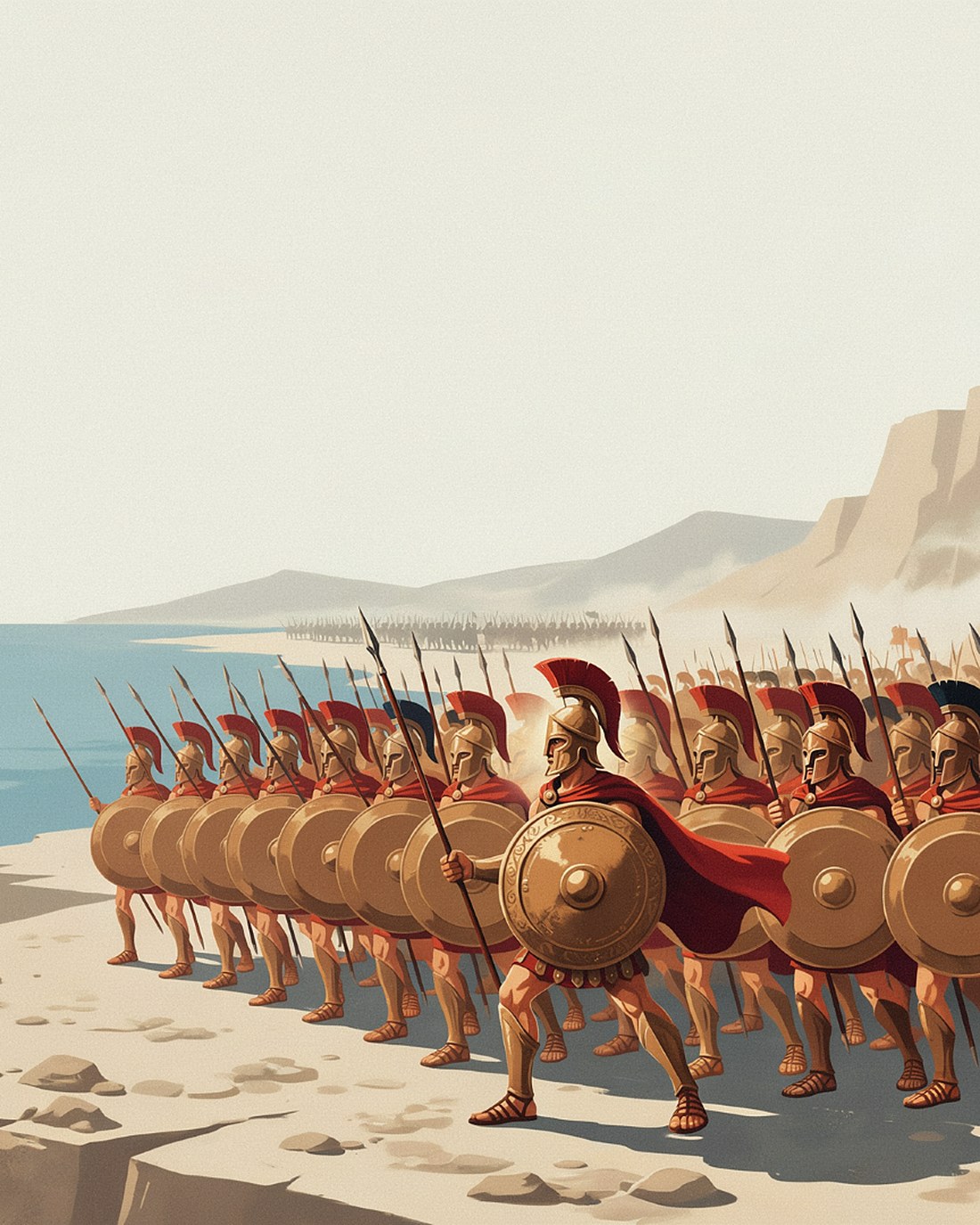
Molon labe: come and take them
In 480 BC, King Leonidas and 300 Spartans held the narrow pass at Thermopylae against a vast Persian army. Ordered to hand over their weapons, Leonidas answered with two words: molon labe, come and take them. Drop it into conversation and you will get a knowing grin.
Say it: mo-LOHN lah-VEH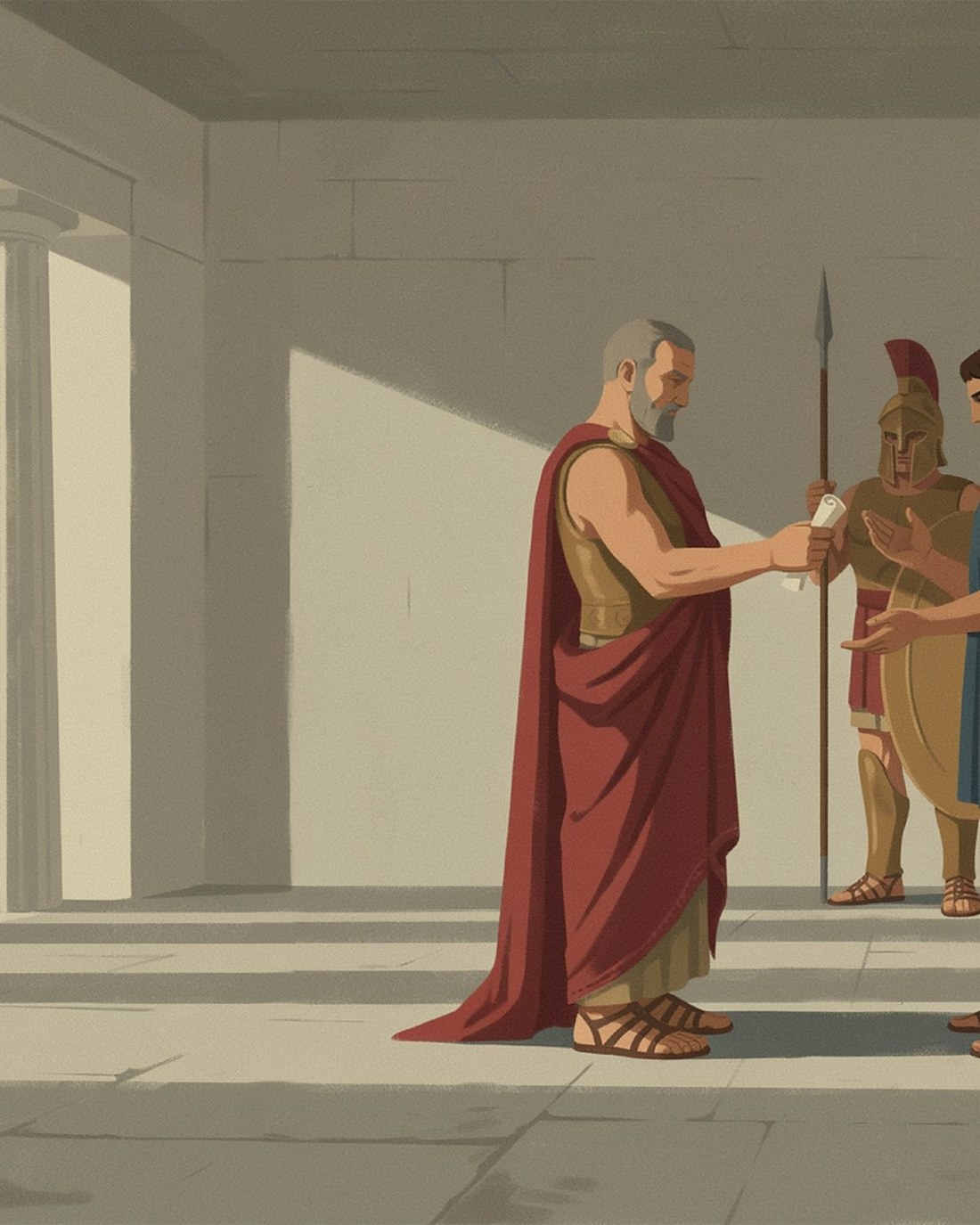
The one word reply
Philip II of Macedon, father of Alexander, warned Sparta: if I invade, I will raze your city to the ground. The Spartans answered with a single word: if. Their homeland was Laconia, which is exactly where we get laconic, few words and dry wit. Greeks are quietly proud of it.
Good to know: the root of the word laconic
The first marathon
By legend, the runner Pheidippides carried news of the victory at Marathon all the way to Athens, gasped nenikekamen, we have won, and collapsed. That run, about 40 km, is why the race is called the marathon. A perfect thing to mention if you have ever run one.
Say it: neh-nee-KAH-menGreece gave the world democracy, philosophy, theatre and the Olympic Games. A little sincere awe for that, mentioned in passing, goes a long way.
No links here, nothing to buy. This part is just to help you travel well.
Sources, and how this guide was checked
Last reviewedJul 2026, 9 of 9 dated items inside their review window
Last actually changedAug 2025see the record →
Not yet individually datedWe date this guide and the fees most likely to move, but the 5 per-place tourist tax rates on this page do not carry a check date yet. They are reviewed with the guide rather than on their own schedule, and putting each of them on one is work in progress.
What the last check foundSources added. Verified with AADE, the Greek tax authority, that the climate crisis resilience fee is charged per room per night (not per person), by the accommodation's star rating and season (higher from April to October), with standard VAT at 24%. The guide's figures are current.
- AADE (Greek tax authority)the climate crisis resilience fee charged per room per night by category and season
Our own judgmentThe daily cash share, tipping norms, and likely ATM behavior are our own estimate from experience, not an official figure.
How we checkHow every guide is researched, checked and dated
More money guides in Europe
If you are also weighing up nearby destinations, each guide covers cards, cash, ATMs and the fees to expect.




Going deeper on Greece
The money questions people ask on the ground.
Short, focused answers to the specific things that catch first-timers out in Greece.
- Greece's climate resilience fee, per room, per night.Greece charges a nightly fee on your accommodation, set by official category and by season. It is charged per room rather than per person, and that last detail is where most travelers get it wrong. Here is what to expect in 2026.
- Do I need cash in Greece, or can I use cards?Short answer: cards work in the cities and big resorts, but carry euro cash for tavernas, kiosks and the smaller islands. Here is how to handle it.
- Tipping in GreeceGreece has a modest tipping culture. Staff earn a wage, tips are appreciated rather than expected, and there is no US-style percentage. Here is what you actually owe, and when to check the bill first.
- Taxis in Greece, and the Athens airport flat fareGreek taxis are cheap and useful, but a few meter games target visitors, especially at the port and on the islands. Here is which app to install, the airport fare fixed by law, and how to keep the meter honest.
- Bringing your dog or cat to Greece.Greece runs on the single EU pet-entry process for a US-origin dog or cat: microchip, rabies in the right order, and an EU health certificate on a 10-day clock. No quarantine, no rabies titer. Here is what that means for Greece, and the local parts worth knowing.
- Common money scams in Greece, and what they cost youGreece has a reputation for taxi trouble that is now mostly out of date, and one setup in central Athens that is still worth knowing about. The useful thing is that the airport fare is fixed by law, so the biggest number of your trip is already decided.
- Staying connected in Greece.Greece covers its cities and its big islands well, so the decision is mostly financial. The exception is the bit of a Greek holiday that involves being on a boat, where everybody loses signal equally.
- What does getting sick in Greece cost a visitor?Most American trips to Greece happen on islands, and that is what shapes this page. The everyday side is cheap and close. The serious case gets on a boat or a helicopter to Athens, and the US Embassy is explicit about who pays for the ride.
This is how Greece stands today.
Money rules move. We can let you know for free if that changes.